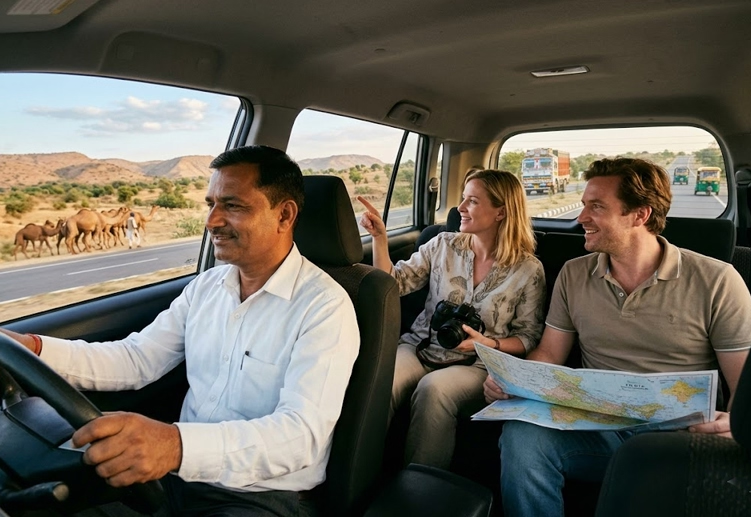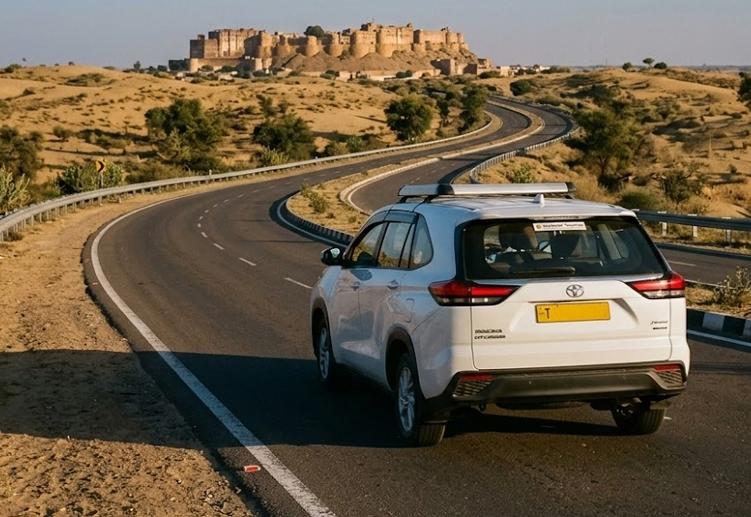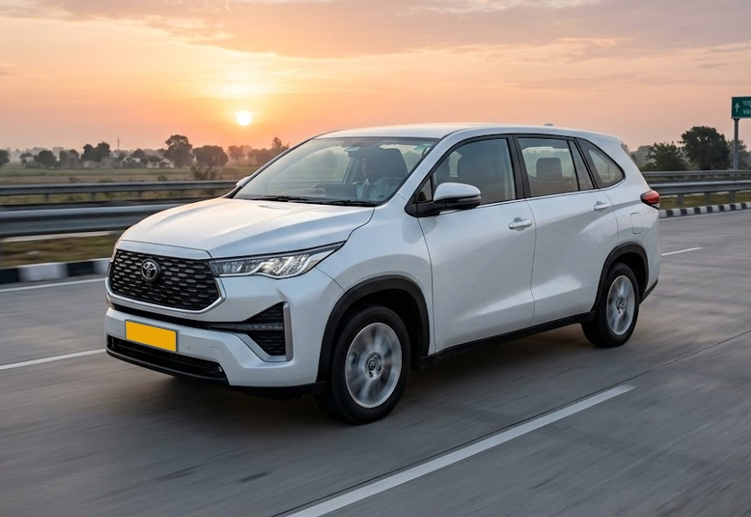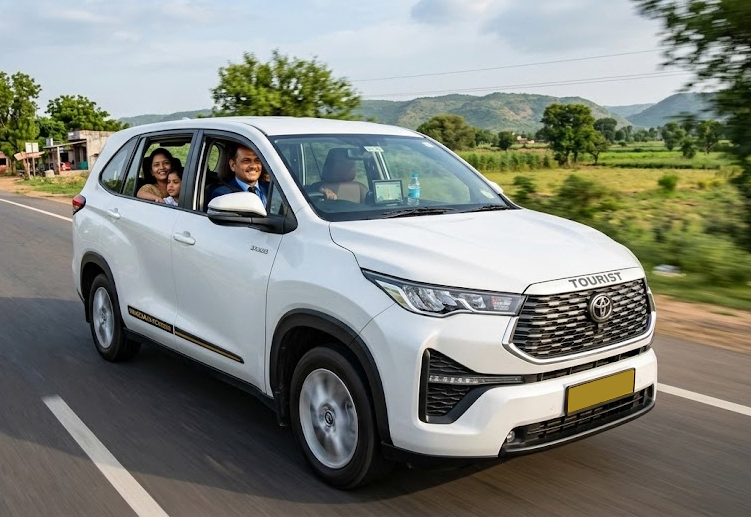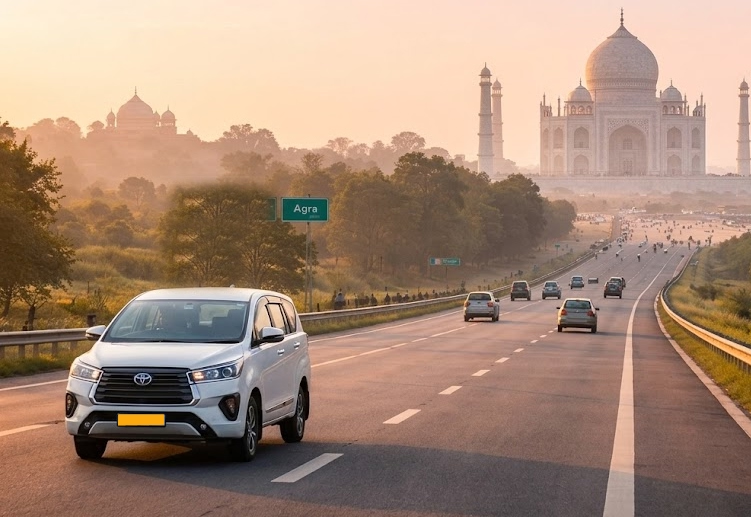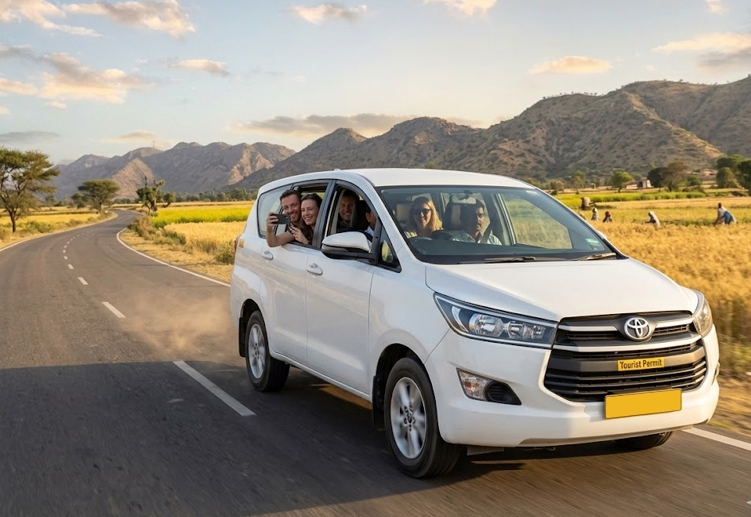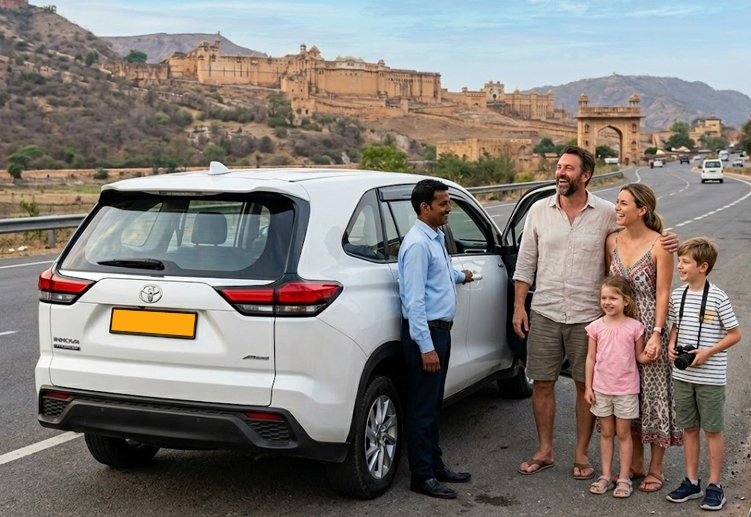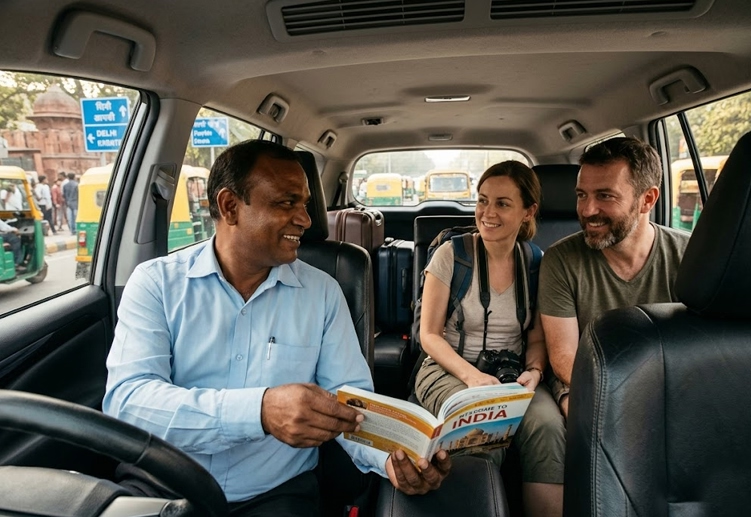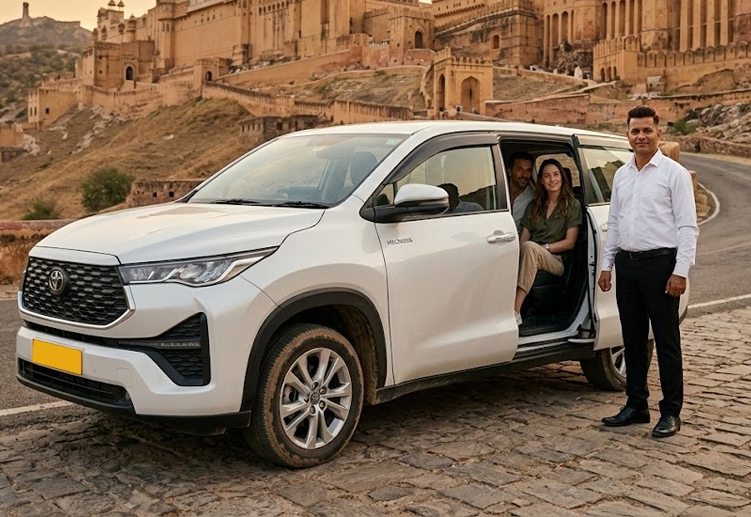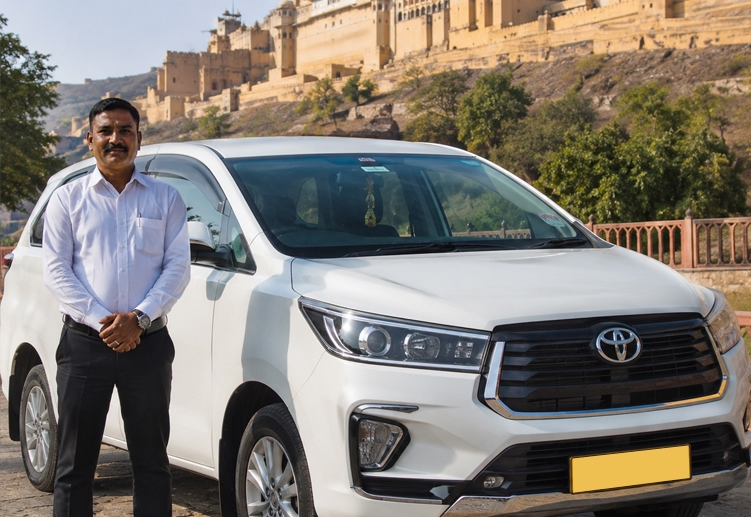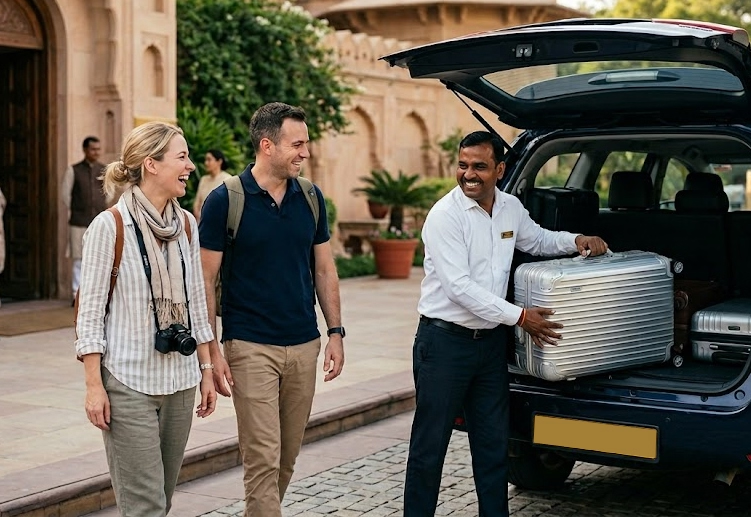


For an international traveler, a professionally operated private car with driver in India is best budgeted at roughly ₹5,500 to ₹11,500 per day for the vehicles most couples and families actually use. A comfortable sedan generally sits at the lower end, while an Innova, Innova Crysta or comparable roomy vehicle costs more. Larger vans, premium SUVs and luxury cars can go well beyond that range. These are intentionally comfort-first planning figures rather than the cheapest local taxi rates, because a multi-day touring service is not the same product as hiring a driver for a few hours inside one city.
The confusing part is that the phrase private driver in India is used for several completely different services. One website may quote only the driver's labour. Another may quote a city taxi for eight hours and 80 kilometres. A third may quote an outstation vehicle by the kilometre. A specialist touring company may give one all-inclusive figure covering the car, fuel, chauffeur, interstate taxes, tolls, parking and the driver's overnight expenses. All four prices can be genuine, but comparing them as if they are the same thing creates unrealistic expectations.
This guide is written for travelers from the United States, United Kingdom, Europe, Australia, Canada and other international markets who want a reliable private road journey rather than the absolute cheapest fare. It explains what a fair planning budget looks like, why quotes vary, what should be included, which vehicle is worth paying more for, how Rajasthan and the Golden Triangle are normally priced, how much to allow for tipping, and which questions expose a weak quotation before you send a deposit.
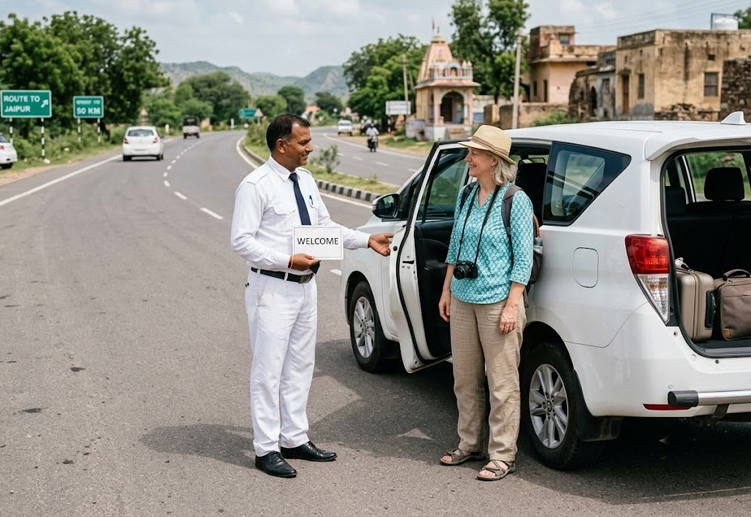
Private Driver Cost in India: Quick Answer
If you simply want a realistic number to begin planning, use the following higher-comfort ranges for a private air-conditioned tourist vehicle with a professional driver. They assume a well-maintained car, normal touring use, an experienced driver and a quotation designed for foreign visitors. Exact pricing still depends on distance, city, season and inclusions.
| Vehicle | Comfortable use | Planning rate / day | Approx. USD |
|---|---|---|---|
| Sedan Dzire / Etios / similar | 1–2 travelers with normal luggage | ₹5,500–₹7,500 | $58–$79 |
| MPV / SUV Ertiga / Innova | 2–4 travelers, more bags | ₹7,000–₹9,500 | $74–$100 |
| Innova Crysta | 2–5 travelers prioritizing road comfort | ₹8,500–₹11,500 | $90–$121 |
| Tempo Traveller | 6–12 travelers | ₹12,000–₹16,500 | $126–$174 |
| Force Urbania / premium van | Small groups wanting more space | ₹15,000–₹22,000 | $158–$232 |
| Luxury sedan / premium SUV | Executive or luxury travel | ₹20,000–₹35,000+ | $211–$369+ |
Do not read that table as a national tariff. India does not have one fixed private-tourist-driver price. A Delhi airport transfer, eight-hour Jaipur sightseeing day, 300-kilometre outstation drive and two-week Rajasthan circuit all use different commercial logic. The table is a sensible budgeting level for travelers who prefer a dependable car, a capable driver and a transparent quote rather than a bargain-basement operator.
Why Online Prices for a Private Driver in India Look So Different
You can find remarkably low figures online, and many are technically correct. The problem is the missing context. A price of ₹1,000 or ₹1,500 per day may refer to a driver who operates your own car. A ₹2,000 city package may be limited to eight hours and 80 kilometres. A ₹13-per-kilometre outstation rate may exclude tolls, interstate taxes, parking, driver allowance and a minimum 250-kilometre daily billing rule. A premium touring quote may bundle all of those items into one figure.
For an international visitor, the useful comparison is not “what is the lowest number I can find?” It is “what will I actually pay for the complete movement I need?” A cheap quote can become expensive once you add extra kilometres, night charges, driver accommodation, highway tolls, state permits, airport waiting, parking and a vehicle upgrade because the original car is too small for the luggage.
There are four common pricing models
- Driver only: you supply the vehicle; the fee is mainly the driver's time and labour.
- Local car + driver package: usually limited by hours and kilometres, such as 8 hours / 80 km.
- Outstation per-kilometre hire: you pay a vehicle rate multiplied by billed distance, often with a daily minimum.
- Multi-day all-inclusive tour quote: one itinerary price covering most transport-related operating costs.
For a first trip to India, the fourth model is often easiest to understand because you can see the transport budget before you arrive. It is also the model that makes the most sense for a route such as Delhi–Agra–Jaipur–Pushkar–Jodhpur–Udaipur, where paying separate small amounts every day becomes tiring.
Driver Only vs Car with Driver: Do Not Confuse the Two
This distinction matters more than almost anything else in the price discussion. If an Indian resident says they pay a driver ₹1,000 for a full day, they may already own the car. Their payment does not need to cover the vehicle's purchase cost, depreciation, tyres, servicing, commercial insurance, tourist permits, fuel or business overhead.
An international traveler normally needs the complete car-and-driver service. That means a commercially suitable vehicle arrives at the airport or hotel, stays available according to the agreed itinerary, carries luggage, covers intercity roads and continues with you from destination to destination. The operator has to price the vehicle as well as the person driving it.
That is why comparing a driver's daily wage with a chauffeur-driven touring quotation is misleading. It is the same reason a restaurant meal costs more than the raw ingredients: the final service includes far more than one component.
What Should a Good Private Driver Quote Include?
A professional quotation should be easy enough to understand that you can explain it back to the operator in one sentence. For a multi-day tourist route, ask whether the following are included before you compare two offers.
Hotels for travelers, meals, monument tickets, licensed local guides, safari tickets, domestic flights and personal shopping are normally separate unless you have booked a complete tour package. Tipping should also be treated separately because it is voluntary and should reflect service quality.
How Much Does a Sedan with Private Driver Cost?
A sedan is the value choice for one or two travelers who pack sensibly. For a comfort-first international booking, allow around ₹5,500–₹7,500 per touring day, or roughly $58–$79 at the planning exchange rate used in this guide.
A cheaper sedan can certainly be found in many cities, particularly for limited local use. The higher planning range is intended for people who want the quotation to absorb normal touring costs and who would rather pay a little more for a cleaner, newer or better-managed service. The biggest mistake couples make is assuming every four-seat car is comfortable for two adults plus two large suitcases, cabin bags and shopping. Boot shape matters as much as passenger count.
For Delhi and Jaipur local sightseeing, a sedan is usually fine. For a long Rajasthan circuit, it can still work well if luggage is light. If you are tall, plan several five-hour road days, or travel with large hard-shell cases, upgrading to an Innova-type vehicle is often money well spent.
How Much Does an Innova or Innova Crysta with Driver Cost?
The Toyota Innova family is popular with international visitors because it sits in a useful middle ground: more upright seating, better road presence, flexible luggage space and generally better comfort on long days than a compact sedan. For a standard Innova or similar MPV, a practical premium planning range is ₹7,000–₹9,500 per day. For an Innova Crysta, allow approximately ₹8,500–₹11,500 per day when you want a strong all-round touring setup.
Those figures are above many low advertised city tariffs, deliberately. A local eight-hour package is not the same as having the vehicle travel 1,500–2,500 kilometres over a multi-state itinerary. When the quote includes fuel, driver expenses and other road costs, the apparent daily number becomes easier to justify.
Tempo Traveller and Force Urbania Costs for Groups
Groups should think in terms of cost per person and luggage comfort, not simply the total vehicle price. A Tempo Traveller may cost approximately ₹12,000–₹16,500 per day for a quality tourist setup. A newer premium van such as a Force Urbania can reasonably be budgeted at ₹15,000–₹22,000 per day, depending on seating configuration, route, daily distance and the standard of the vehicle.
For eight travelers, even a ₹16,000 daily van works out to ₹2,000 per person before hotels and sightseeing. That can be a strong value when compared with splitting the group into several cars, especially if everyone wants to arrive together and keep luggage in one place. The comfort question is again important: ask how many usable luggage spaces remain when every passenger seat is occupied.
Luxury Chauffeur Prices in India
Luxury vehicle pricing is much less predictable because the term covers very different cars. A Toyota Fortuner may be marketed as premium by one company, while another reserves “luxury” for Mercedes-Benz, BMW or Audi models. For genuine premium chauffeur service, a realistic planning budget begins around ₹20,000 per day and can climb to ₹35,000 or far more depending on the model, hours, distance and city.
Luxury cars become particularly expensive on multi-city itineraries because operators need to account for the vehicle being away from its home base, higher maintenance costs, specialized availability and potentially empty return movement. If you want luxury only for an airport arrival, wedding event or business day, booking it locally can be more economical than keeping the same high-end car for an entire Rajasthan circuit.
Private Driver Cost for the Golden Triangle
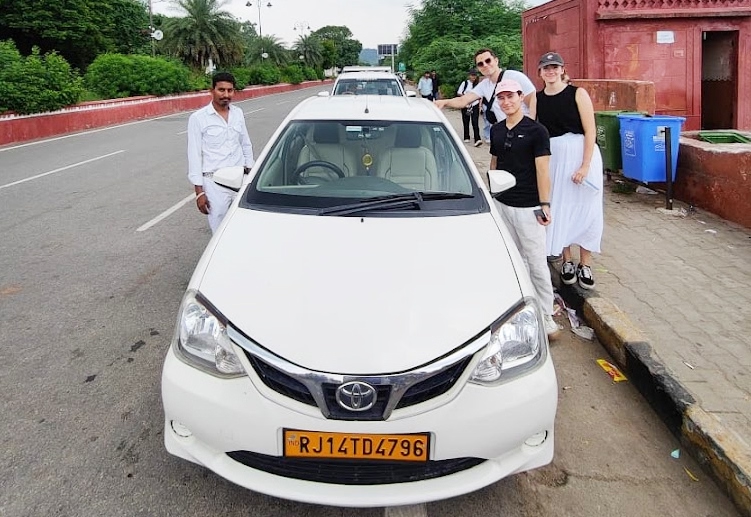
The Delhi–Agra–Jaipur circuit is the easiest route on which to understand private-driver pricing because it is heavily traveled, road connections are established and operators know the logistics well. The cheapest online packages can be much lower, but for a well-managed service aimed at international guests, the following budget gives room for comfort and normal operating costs.
| Golden Triangle duration | Sedan planning budget | Innova / Crysta planning budget | Approx. USD range |
|---|---|---|---|
| 3 days | ₹18,000–₹24,000 | ₹25,000–₹33,000 | $190–$348 |
| 4 days | ₹23,000–₹31,000 | ₹32,000–₹43,000 | $242–$453 |
| 5 days | ₹28,000–₹38,000 | ₹39,000–₹54,000 | $295–$569 |
| 7 days | ₹38,000–₹52,000 | ₹54,000–₹74,000 | $400–$780 |
The route order changes the total distance. So do airport pickups, extra Delhi sightseeing, a Fatehpur Sikri stop, a detour to Abhaneri, an additional Jaipur day, or returning the car to Delhi after Jaipur. Always send the complete route when requesting the quote instead of asking only for a “five-day Golden Triangle price.”
If you are comparing this with a train-based itinerary, remember that a private car covers the last mile automatically. With trains, you still need transfers between airport, hotel and railway station, plus local transport for sightseeing. Trains can be excellent, but they are a different travel style rather than a directly comparable service.
How Much Does a Private Driver Cost for Rajasthan?
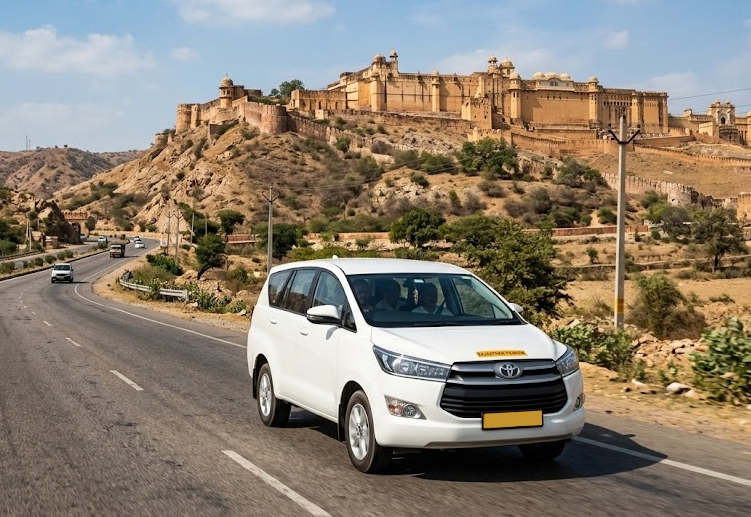
Rajasthan is where a private driver becomes especially useful because the classic cities form an overland network. Jaipur, Pushkar, Jodhpur, Udaipur, Jaisalmer, Bikaner, Bundi, Ranthambore and smaller heritage stops are much easier to connect when the car stays with you. Distances are not extreme by Indian standards, but repeated packing, station transfers and separate taxis can make an ambitious itinerary feel fragmented.
For a comfort-focused multi-day Rajasthan tour, a sedan can reasonably be budgeted around ₹6,000–₹8,000 per day and an Innova Crysta around ₹8,500–₹11,500 per day, before any unusual route premium. Longer desert runs, extensive one-way routing or seasonal scarcity can push the effective daily cost higher.
| Example Rajasthan trip | Sedan | Innova / Crysta | Notes |
|---|---|---|---|
| 7 days | ₹42,000–₹56,000 | ₹60,000–₹80,000 | Good for Jaipur–Jodhpur–Udaipur style routes |
| 10 days | ₹58,000–₹78,000 | ₹82,000–₹1,08,000 | Allows a broader heritage circuit |
| 14 days | ₹80,000–₹1,08,000 | ₹1,12,000–₹1,48,000 | Suitable for a more complete Rajasthan journey |
These are planning budgets, not promises that every route will cost exactly this amount. A Jaipur–Jodhpur–Udaipur trip is not the same as Delhi–Mandawa–Bikaner–Jaisalmer–Jodhpur–Udaipur–Pushkar–Jaipur–Agra. The second route covers far more ground and ties up the vehicle for longer.
Sample Intercity Route Budgets
One-way routes are often priced differently from multi-day tours because the car may have to return empty or reposition for the next booking. For an Innova Crysta or comparable comfort vehicle, international travelers can use these higher-side planning figures as a starting point before requesting a live quote.
| Route | Comfort vehicle planning range | Approx. USD |
|---|---|---|
| Delhi → Agra | ₹7,500–₹10,000 | $79–$105 |
| Delhi → Jaipur | ₹8,500–₹11,500 | $90–$121 |
| Agra → Jaipur | ₹8,000–₹11,000 | $84–$116 |
| Jaipur → Jodhpur | ₹9,000–₹12,500 | $95–$132 |
| Jaipur → Udaipur | ₹10,000–₹14,000 | $105–$147 |
| Jodhpur → Udaipur via Ranakpur | ₹9,000–₹13,000 | $95–$137 |
| Jodhpur → Jaisalmer | ₹9,000–₹12,500 | $95–$132 |
A route with sightseeing stops should be quoted as such. Agra to Jaipur via Fatehpur Sikri and Abhaneri, for example, requires more time than a direct transfer. Jodhpur to Udaipur via Ranakpur is a touring day rather than simply moving from hotel A to hotel B. Describe the day accurately and you are much less likely to face an argument about extra distance later.
How Per-Kilometre Pricing Works
Some Indian operators prefer a simple per-kilometre model for outstation trips. Typical advertised market rates can be much lower than the premium day-rate budgets above because extras may be charged separately. As a broad planning concept, sedans are often seen in the low-to-mid teens per kilometre, Innova-type vehicles in the high teens or low twenties, and larger vans above that.
The important detail is the minimum kilometres per day. If a company applies a 250 km daily minimum and you travel only 120 km on a sightseeing day, you may still be billed for 250 km. Over ten days that can mean a 2,500 km minimum even if the odometer movement is lower.
Simple example
If an Innova Crysta is billed at ₹20/km with a 250 km daily minimum, the vehicle component effectively begins around ₹5,000 per day before any separate driver allowance, tolls, parking, interstate permits, GST or night halt. This is why a ₹20/km headline price cannot be compared directly with an ₹8,500 all-inclusive daily quotation.
What Makes the Price Go Up?
Vehicle quality. A newer Crysta with clean upholstery, working rear AC and proper luggage space costs more to operate than an older compact sedan. That difference matters when you spend four or five hours in the car repeatedly.
Total distance. A multi-city itinerary with 300 km every other day uses more fuel and vehicle life than a Delhi sightseeing booking where the car moves 60 km.
One-way positioning. If the vehicle finishes far from its operating base, the operator may need to account for a return journey without a paying guest.
Peak dates. Christmas, New Year, major Indian festivals, wedding season and the most comfortable winter travel months can tighten vehicle availability. Good drivers also get booked earlier.
Driver standard. A chauffeur who has years of experience with foreign travelers, understands airport procedures, keeps sensible road hours and communicates clearly in English is a more valuable service than simply assigning the nearest available driver.
Late-night or unusual hours. Airport pickups at 2 a.m., very early Taj Mahal departures and extremely long driving days may carry extra charges or require different planning for safety.
Mountain routes. Himalayan driving, difficult roads and special permits can change both vehicle choice and cost. Do not assume a Rajasthan rate applies nationwide.
When a Cheap Quote Is Actually More Expensive
A low quote can be genuine and still be the wrong purchase for your trip. Suppose Company A quotes ₹55,000 for ten days and Company B quotes ₹75,000. At first glance the decision looks obvious. Then you discover Company A excludes tolls, parking, interstate tax, driver accommodation, airport waiting and charges for every kilometre above a low daily allowance. Company B includes almost everything. The final totals can end up much closer than the headline numbers suggest.
There is also a non-financial cost to a weak booking. A vehicle that is too small creates discomfort every day. An unfamiliar substitute driver can make communication harder. A company that pressures you toward commission shops can reduce the value of your sightseeing time. A driver who is expected to cover unsafe hours because the itinerary is badly designed can make the journey worse no matter how cheap the car was.
How Much Should You Tip a Private Driver in India?
Tipping is common in tourism but it is not a compulsory percentage in the way some visitors may be used to at home. For a multi-day private driver who has given good service, a practical range is approximately ₹400–₹700 per day, normally presented as one amount at the end of the trip. If the service has been exceptional, you can give more. If it has been poor, you are not required to reward it.
For a one-day service, roughly ₹300–₹700 is a useful starting range depending on the hours and help provided. A long, demanding touring day with luggage support is different from a short airport transfer. Always think of the tip as a thank-you rather than part of the contractual fare.
It is easiest to tip in Indian rupees. Foreign coins are especially inconvenient because they cannot normally be exchanged. If a quote says “gratuity included,” ask exactly what that means; most private car-and-driver quotations leave tipping to the guest.
Should International Travelers Pay in INR or USD?
Ask for the final quotation in Indian rupees even if the operator also provides a USD estimate. INR removes ambiguity when exchange rates change between enquiry and travel. If you are quoted in dollars, ask whether the amount is fixed in USD or simply a conversion of an INR price.
For card or online payments, check whether the payment gateway adds a percentage fee. For cash, ask whether a deposit is required and whether the balance is due on arrival, during the tour or at the end. Never send a large untraceable payment simply because someone offers a small discount.
Is a Private Driver Worth the Cost in India?
For a one-city trip where you are staying in central Delhi or Mumbai and only making a few journeys, app-based taxis may be perfectly sufficient. A private driver becomes more valuable as the itinerary gains complexity.
On a Golden Triangle or Rajasthan route, the car is doing much more than taking you from one attraction to another. It is carrying your luggage between hotels, waiting during sightseeing, linking cities without station transfers, allowing photo and meal stops, and giving you one consistent point of transport contact. That continuity is what travelers are paying for.
Couples often find the cost reasonable because the vehicle price is shared by two people. Families can find it even better value because four airline or train tickets plus multiple transfers begin to add up. Senior travelers value not having to repeatedly move bags. Solo travelers pay more per person, but may consider the additional control and continuity worthwhile.
Which Vehicle Gives the Best Value?
Solo traveler: A sedan is usually financially sensible unless you want maximum space or have a large amount of luggage.
Couple: A sedan works for a short trip, but an Innova or Crysta can be a noticeable comfort upgrade on a 7–14 day route.
Three or four adults: Do not squeeze into a small sedan just because the seat count appears to work. An Innova-type vehicle is a better starting point.
Family with children: Choose based on luggage, child seats and road-day length rather than only passenger count.
Five or more adults: Compare a large MPV against a Tempo Traveller. Once everyone has full-size luggage, a larger vehicle can be considerably more comfortable.
Eight or more travelers: A quality Tempo Traveller or Force Urbania often gives a better group experience than splitting into multiple cars, particularly when you want to stay together.
What an English-Speaking Driver Should and Should Not Do
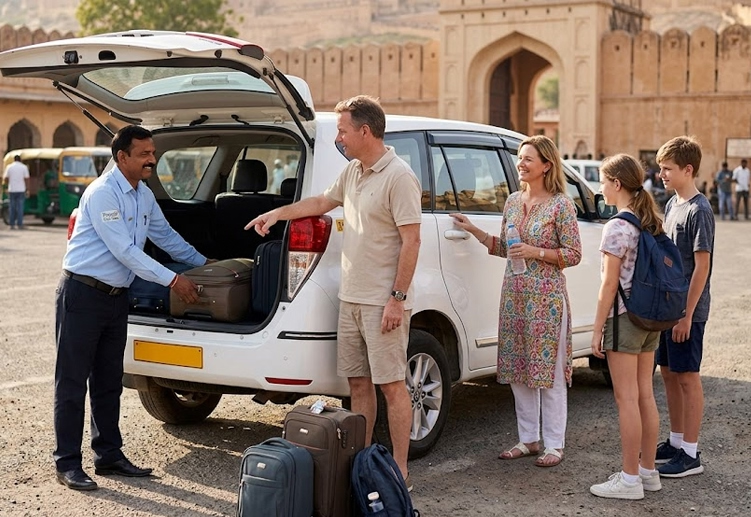
An English-speaking driver does not need to sound like a professional tour guide. The useful standard is practical communication: confirming pickup time, understanding your hotel, discussing a lunch stop, explaining how long the next drive takes, coordinating with local staff and handling itinerary changes without confusion.
A driver can share everyday observations and practical local advice, but they are not automatically a licensed monument guide. At major historical sites, a knowledgeable local guide can provide much deeper context. Treat the two roles separately when planning the budget.
Good drivers also understand boundaries. They should not force shopping stops, pressure you to use a particular restaurant, or change your itinerary because they earn commission somewhere. Recommendations can be useful; pressure is different. If shopping is not your priority, say so clearly before the tour begins.
Questions to Ask Before Booking
- Is this the total price for my exact itinerary? Ask them to list every city and transfer.
- Which vehicle model or category is confirmed? “SUV” can mean very different levels of comfort.
- How many large suitcases will fit without using passenger seats?
- Are fuel, tolls, parking and interstate taxes included?
- Is the driver's food and accommodation included?
- Is there a kilometre limit or minimum kilometre calculation?
- What is the extra-kilometre and extra-hour rate?
- Are airport pickup and final drop included?
- Will the same driver stay with us throughout the multi-day route?
- Does the driver communicate comfortably in English?
- What happens if the vehicle breaks down?
- What is the cancellation and refund policy?
- How much deposit is required, and how can it be paid?
- Are guides, entry tickets and traveler hotels excluded?
- Are shopping stops optional? The answer should be yes.
Red Flags in a Private Driver Quote
No vehicle detail. If the quote just says “AC car,” you do not know what you are buying.
No inclusion list. A total without explaining tolls, fuel, parking and driver expenses is difficult to compare.
Unrealistic driving schedule. A company that agrees to every impossible day without questioning the itinerary may be more interested in securing the booking than delivering a good trip.
Pressure to pay everything immediately. A normal deposit can be reasonable. High-pressure payment demands deserve caution.
Guaranteed shopping. If sightseeing appears to be built around commission stops, the cheap transport price may be subsidized by where the driver expects you to shop.
Repeated last-minute vehicle changes. Always ask what “or similar” means and whether a downgrade changes the price.
How to Get Better Value Without Choosing the Cheapest Driver
The smartest savings come from route design. A well-sequenced itinerary reduces unnecessary kilometres, driver time and hotel changes. For Rajasthan, a logical direction through Jaipur, Jodhpur, Udaipur and Jaisalmer is usually better than repeatedly returning to the same city. For the Golden Triangle, your international flight schedule can determine whether Delhi should be at the beginning, end or both.
Traveling for more days can sometimes reduce the effective daily cost because the operator secures one continuous booking. On the other hand, adding days with almost no vehicle use may not save as much as expected because the car and driver are still reserved for you.
Vehicle choice is another place to be smart. A couple does not need a premium van, but they also should not under-buy if they have several long road days. Spend where comfort changes the experience. Save where the upgrade adds little value.
Example Budget: 10-Day North India Trip for Two
Imagine two travelers planning Delhi, Agra, Jaipur, Jodhpur and Udaipur over ten days. They want a comfortable vehicle, airport pickup, hotel-to-hotel travel and normal sightseeing availability. They have two large suitcases and prefer the extra comfort of an Innova Crysta.
Comfort-first transport budget
- Private Innova Crysta + professional driver: approximately ₹85,000–₹1,05,000
- Approximate USD at ₹95/$1: $895–$1,105
- Optional driver tip for very good service: roughly ₹4,000–₹7,000 total
- Hotels, meals, monument tickets and local guides: separate
That may be more than the cheapest quote you find online. It is intentionally framed as a comfortable international-traveler budget with room for a strong vehicle and well-managed touring service. If your itinerary is shorter, distance is lower, or you use a sedan, the cost can fall. If you travel over Christmas/New Year, request a luxury model, add Jaisalmer or demand very long road days, it can rise.
Example Budget: 7-Day Golden Triangle for a Couple
For Delhi, Agra and Jaipur with a relaxed pace, one or two extra sightseeing days and airport transfers, a couple can budget approximately ₹38,000–₹52,000 for a good sedan or ₹54,000–₹74,000 for an Innova/Crysta-style comfort vehicle. In USD, that is roughly $400–$780 depending on the vehicle and final inclusions.
The per-person transport cost for two guests is therefore often far less intimidating than the total number appears. More importantly, the same vehicle handles every hotel move and most sightseeing transport. That is the practical advantage international visitors often value after the trip begins.
How Far in Advance Should You Book?
For ordinary dates, several weeks is usually enough to find options, but the strongest drivers and preferred vehicle models can be allocated earlier. For October through March, Christmas/New Year, major festivals or a specific luxury vehicle, booking earlier is sensible. If you are traveling during the hot summer or monsoon period, availability may be easier, but route conditions and sightseeing times deserve more attention.
You do not necessarily need to lock every restaurant and sightseeing hour months in advance. The key is to confirm the broad route, pickup date, vehicle category and commercial terms. A good private-driver trip should retain some flexibility.
Private Driver Prices by Major Tourist City
City pricing matters because the same vehicle can have a different operating cost in Delhi, Jaipur, Mumbai, Kochi or a smaller Rajasthan town. Airport demand, commercial parking, traffic time, vehicle supply and local permit rules all affect the quotation. A traveler should therefore resist the temptation to take a Jaipur local rate and assume it applies everywhere in India.
Delhi: Delhi normally has strong vehicle availability, but airport pickups, long traffic hours and NCR movement can raise the total. A good sedan for a full sightseeing day can be budgeted around ₹5,500–₹7,000 for a comfort-focused booking, while an Innova or Crysta can reasonably sit around ₹8,000–₹10,500 depending on hours and inclusions. Airport-only transfers are much cheaper because the car is not reserved all day.
Agra: Agra itself is compact, so a local sightseeing vehicle may cost less than a full Delhi day. However, most international visitors arrive from Delhi or continue to Jaipur, meaning the real transport cost often comes from the intercity leg rather than the local sightseeing mileage. If you are visiting the Taj Mahal at sunrise, confirm how early the driver is expected to report and whether hotel pickup is included.
Jaipur: Jaipur has many local operators and therefore a very wide price spread. Eight-hour city packages can look inexpensive online, but a professional private touring service with a better vehicle and international-guest support should be budgeted at a higher level. For a comfort-first day, a sedan around ₹5,000–₹7,000 and an Innova Crysta around ₹7,500–₹10,500 is a reasonable planning approach.
Udaipur and Jodhpur: Both cities can be explored efficiently by car, but they are also important points on longer Rajasthan routes. A traveler staying only in the city may not need a vehicle all day. A traveler arriving from another region and continuing onward should request a combined intercity and sightseeing quote, because this can be much more efficient than booking separate transfers.
Mumbai, Bengaluru and other large metros: Heavy traffic means a vehicle can spend many hours covering relatively little distance. In these cities, time limits may matter more than kilometre limits. If your itinerary involves business meetings, airport transfers and hotel waiting, clarify the hourly overtime policy before booking.
Kerala and South India: Routes such as Kochi–Munnar–Thekkady–Alleppey are often sold as multi-day car-and-driver circuits. Distances can look short on a map, but hill roads reduce average speed. A driver experienced with the route is more valuable than a low kilometre rate. Treat a South India circuit as a separate quote rather than applying North India prices blindly.
Local Sightseeing Price vs Multi-Day Touring Price
A local sightseeing car is usually sold as a fixed time-and-distance package. Eight hours and 80 kilometres is common. That model suits a day in Jaipur, Delhi or Udaipur because the vehicle returns to its home base at night. The operator can use it for another booking the following morning, and there is no driver accommodation cost.
A multi-day touring car is different. The driver may sleep away from home for a week, the car may travel hundreds of kilometres between cities, and the operator cannot use the vehicle for another customer. Fuel, tyres, service intervals and commercial wear all increase. This is why a traveler should not multiply a local city rate by ten and expect that to be the correct price for a ten-day Rajasthan tour.
When you receive a multi-day quote, ask whether sightseeing within each overnight city is included. Some operators price only the intercity transfers, leaving you to hire another taxi for local touring. Others keep the same car available during the day. Both models can work, but the second is more convenient and should naturally cost more.
How Season Changes Private Driver Prices
India's tourist seasons are not uniform, but North India and Rajasthan see their strongest international leisure demand during the cooler months. From roughly October through March, comfortable weather attracts more visitors. Christmas and New Year can be especially busy. When the best drivers and newer vehicles are already committed, last-minute customers may be left with higher prices or fewer choices.
Summer can bring lower demand in Rajasthan because daytime temperatures are intense. The transport price may soften, but hotel savings are often more dramatic than driver savings because fuel and operating costs remain. Air conditioning also works harder. If you travel in May or June, a well-maintained AC system matters more than saving a small amount on the daily fare.
Monsoon conditions vary by region. In Rajasthan, rain can be intermittent; in parts of South India it is a much stronger seasonal factor. Road conditions and hill routes can slow journeys. The best price is therefore not always the lowest number. The right driver for the season and route can prevent a difficult day from becoming an exhausting one.
Does the Driver Sleep at Your Hotel?
Usually no. Drivers on multi-day tours often use dedicated driver accommodation, a staff room at the hotel, a nearby budget property or an allowance arranged by the operator. International travelers generally should not have to organize this themselves if the quote says driver expenses are included.
Some hotels offer free or low-cost driver lodging; others do not. This is one reason overnight costs vary by route and property. If a driver asks you unexpectedly for cash every night despite the operator having promised an all-inclusive quote, contact the company before paying. A transparent booking should make this clear from the start.
The driver's meals are handled similarly. In a professionally managed tour, you are not expected to invite the driver to every restaurant or pay for every meal. You can certainly offer tea or a meal if you wish, but it should be hospitality rather than an obligation created by an unclear contract.
How Much Luggage Changes the Right Car
Luggage is one of the least discussed factors in India car-and-driver pricing, yet it is one of the most important. International travelers often carry more baggage than domestic passengers: large checked suitcases, cabin bags, camera equipment, shopping and sometimes mobility aids. A vehicle that appears large enough on a seating chart can become uncomfortable once luggage is loaded.
For a couple with two medium or large suitcases, a sedan may work, but ask for a boot photo if luggage is bulky. Three adults with three large suitcases should normally look at an Innova-type vehicle. Four adults on a long Rajasthan route should strongly consider a Crysta or larger MPV even if a cheaper car technically has enough seats.
Roof luggage carriers are common in some parts of India, but many international guests prefer keeping bags inside the vehicle for weather protection and security. If that matters to you, state it before booking. The operator can then recommend the right car rather than discovering the luggage problem at the airport.
Private Driver Cost for Solo Travelers
A solo traveler pays the full vehicle price, so private transport looks expensive on a per-person basis. A ₹6,000 sedan day costs one solo guest ₹6,000, while two people effectively share ₹3,000 each. This is why trains and app taxis can be more economical for a solo visitor making simple city-to-city moves.
However, private transport may still be worth the premium if the itinerary is complex, the traveler has valuable luggage, arrives at awkward hours, wants rural stops or simply values one known driver. Solo guests should ask whether a smaller sedan can be used for the entire route and whether any unused sightseeing days can be priced differently.
Private Driver Cost for Couples and Honeymoon Travelers
Couples are the sweet spot for private-driver value. They can use a sedan comfortably for many routes, split the vehicle cost between two people and keep their bags secure while sightseeing. For a honeymoon or anniversary trip, spending more on a Crysta can make sense because comfort becomes part of the holiday rather than a transport detail.
A couple should also decide whether they want the driver available for evening dinners. Some itineraries assume the driver's day ends after hotel drop-off. If you expect restaurant pickup at 9 p.m. after a full sightseeing day, discuss that in advance so the schedule remains reasonable and the cost is clear.
Private Driver Cost for Families
Families often get excellent value because the vehicle replaces several separate tickets and transfers. Parents also benefit from keeping snacks, jackets, medication and children's items in one place throughout the day. The main cost issue is choosing enough space.
A family of four with four large suitcases should not assume a five-seat vehicle is automatically suitable. Ask for the exact luggage arrangement. If you need child seats, request them early because availability and quality vary. If grandparents are traveling too, step-in height and seat comfort can matter more than the vehicle's advertised capacity.
Private Driver Cost for Senior Travelers
Senior travelers often value private road transport for reasons that are not visible in a rate table. There is less walking through stations with bags, more control over rest breaks, easier hotel-to-hotel movement and the ability to adjust sightseeing after a tiring morning.
For this group, the cheapest sedan is rarely the right benchmark. A vehicle with comfortable entry, supportive seats and dependable air conditioning is usually worth the extra daily spend. Also ask the driver to avoid overly ambitious road days. Saving one hotel night by driving eight or nine hours can reduce the quality of the trip more than the financial saving justifies.
Private Driver vs Taxi Apps: Cost Comparison
Uber, Ola and local taxi apps can be excellent for short urban rides. They are particularly useful when you are staying in one city, do not have much luggage and want transport only when required. For those situations, keeping a private vehicle waiting all day may be unnecessary.
The comparison changes on a road trip. App taxis do not always provide the same driver from one city to the next, and availability can vary outside major urban areas. A private touring car stays attached to the itinerary. You know who is collecting you after sightseeing and you do not need to negotiate a new ride every time you move hotels.
Therefore the app-taxi option can be cheaper in pure rupees while the private-driver option offers more continuity. The right choice depends on whether you are optimizing for minimum transport spend or minimum travel friction.
Private Driver vs Train: Where the Money Really Goes
Indian trains can be a memorable and efficient part of a trip. On routes with fast, convenient services, they may be significantly cheaper than a private car. But the ticket is not the entire transport budget. Add the taxi from the hotel to the station, porter or luggage effort, waiting time, station arrival at the next city and another vehicle to reach the next hotel.
For a couple traveling Delhi–Agra–Jaipur, a train-based plan can still save money. For a family of four, the saving narrows because four tickets plus several transfers add up. If you also want Fatehpur Sikri, Abhaneri or rural stops between cities, a road vehicle can deliver experiences that the train simply cannot.
A mixed itinerary is also possible. Some travelers use trains for one long leg and a private driver for Rajasthan. The best transport plan does not need to use one method exclusively.
Private Driver vs Domestic Flights
Flights make sense for large distances such as Delhi to Mumbai or Rajasthan to Kerala. A driver is not a substitute for flying across the entire country. For shorter distances, however, airport procedures can erase much of the time advantage. Driving from Delhi to Agra is door-to-door; flying would make little sense even if a flight existed at the right time.
For a 250–350 km intercity route, compare hotel-to-hotel time rather than scheduled flight time. Include the drive to the airport, recommended early arrival, security, baggage collection and transfer at the destination. A private car often becomes more competitive than the distance alone suggests.
Insurance, Commercial Permits and Vehicle Documents
A professional tourist vehicle should have the documents required for commercial operation. Travelers do not need to become transport-law experts, but they can ask the company whether the vehicle is commercially insured and authorized for the route. This matters particularly on interstate journeys.
If a quote is dramatically cheaper than every other offer, one possibility is that the vehicle is not being operated to the same commercial standard. The traveler may never notice, but price alone should not be the deciding factor. A reputable company should be comfortable answering basic questions about registration, insurance and driver licensing.
How Deposits and Payments Usually Work
There is no single standard deposit percentage across India. Some operators accept a small advance and collect the balance after arrival. Others require more when they are reserving a premium vehicle, a peak-season trip or a long itinerary. What matters is that the terms are written clearly.
Ask for a booking confirmation showing the company name, passenger name, dates, route, vehicle type, total amount, deposit received and remaining balance. If the payment is being made to a personal account or digital wallet, confirm why and retain the receipt. For a high-value booking, a traceable card or bank payment can provide better records than sending cash-equivalent funds.
If your plans may change, read the cancellation terms before paying. A slightly higher quote with a fair cancellation policy can be better value than a cheaper non-refundable deal months before travel.
What Happens if You Change the Route During the Trip?
One of the advantages of private travel is flexibility, but flexibility is not the same as unlimited mileage. A small sightseeing change within the same city may have no effect on price. Adding an entirely new city, moving the final drop hundreds of kilometres or adding an extra touring day naturally changes the operator's cost.
Agree on how changes will be priced. If the quote is per kilometre, the calculation may be straightforward. If it is an all-inclusive package, ask the company to confirm any extra amount by message before the change. This keeps the traveler and driver out of awkward money discussions on the road.
A Simple Formula for Comparing Two Quotes
Compare the true trip total
True transport cost = quoted car-and-driver price + tolls + parking + interstate taxes + driver allowance/accommodation + extra kilometres + extra hours + payment fees.
If a company includes an item, enter zero for that line. Do the same calculation for every quote. This takes five minutes and is far more useful than sorting offers from cheapest to most expensive by the first number you see.
How to Request a Quote That Gets an Accurate Price
Instead of sending “How much for a driver in India?”, send enough detail for the operator to calculate the real job. Include your arrival date, pickup city, departure city, every overnight stop, number of adults and children, suitcase count, preferred vehicle and any important detours.
A useful enquiry might say: “Two adults, two large suitcases, arriving Delhi airport on 10 November. Delhi 2 nights, Agra 1 night, Jaipur 2 nights, Jodhpur 2 nights, Udaipur 2 nights, final drop Udaipur airport. We prefer Innova Crysta. Please quote vehicle, English-speaking driver, fuel, tolls, parking, interstate taxes and driver expenses.”
That message gives the company enough information to quote properly and gives you enough structure to compare responses. It also signals that you understand the difference between a headline cab fare and a complete private touring service.
Confirm these details in writing
- Exact route and dates: every overnight city, airport pickup and final drop.
- Vehicle category: sedan, Innova, Crysta, Tempo Traveller, Urbania or premium model, with a clear equivalent policy.
- Complete inclusions: fuel, tolls, parking, interstate taxes, driver allowance and overnight expenses.
- Usage policy: daily kilometre or hour limits, minimum billing and extra-use rates.
- Payment terms: deposit, balance date, accepted method, card fees and cancellation conditions.
- Operational backup: who you contact if the vehicle or driver needs to be replaced during the trip.
A Final Cost Checklist Before You Pay a Deposit
Frequently Asked Questions
How much does a private driver cost per day in India?
For international travelers booking a complete tourist car with driver, a sensible comfort-first budget is around ₹5,500–₹7,500 per day for a sedan and ₹8,500–₹11,500 for an Innova Crysta. Local city packages and driver-only services can be cheaper.
Does the private driver price include the car?
Not always. “Driver only” means you provide the vehicle. International tourists normally need a car-and-driver quotation, so confirm that the vehicle, fuel and operating costs are included.
Are fuel and tolls included?
They may be included in an all-inclusive tour quote, but per-kilometre operators often list some road charges separately. Ask for a written inclusion list before comparing prices.
Is an Innova Crysta worth the extra cost?
For long road journeys, tall travelers, families or guests with more luggage, it is often worth the upgrade. Couples on short city trips may be perfectly comfortable in a sedan.
How much is a private driver for the Golden Triangle?
For a 5-day Delhi–Agra–Jaipur itinerary, a comfort-focused planning budget is roughly ₹28,000–₹38,000 for a sedan and ₹39,000–₹54,000 for an Innova/Crysta-type vehicle, depending on routing and inclusions.
How much is a private driver for Rajasthan?
For a multi-day Rajasthan circuit, budget roughly ₹6,000–₹8,000 per touring day for a sedan and ₹8,500–₹11,500 for an Innova Crysta as a higher-comfort starting point. Long routes or peak dates can cost more.
Should I tip my driver?
Tipping is optional but appreciated. Around ₹400–₹700 per day for good multi-day service is a practical reference, usually given as one amount at the end of the journey.
Can I pay in US dollars?
Some operators may accept foreign-currency or card payments, but it is clearer to request the official quote in INR. Exchange rates change, so USD figures should be treated as estimates unless the company explicitly fixes a USD total.
Is a private driver cheaper than trains?
Not necessarily for one person. For couples or families, the comparison becomes closer once station transfers and local taxis are added. A private driver mainly provides door-to-door continuity, luggage convenience and flexible timing.
Is a private driver the same as a tour guide?
No. A good driver manages transport and can share practical local information, but a licensed monument or city guide is a separate professional role and is normally charged separately.
Why are some India driver quotes extremely cheap?
They may be driver-only prices, limited city packages, per-kilometre rates with extras, older vehicles or quotations that exclude tolls and driver expenses. Compare the full service, not only the headline number.
What is the most important thing to confirm before booking?
Get the exact itinerary, vehicle category, total price, kilometre policy, inclusions, payment terms and cancellation conditions in writing. That single step prevents most pricing misunderstandings.
Do peak-season dates increase private driver prices in India?
They can. Cooler months, Christmas and New Year, major festivals and busy wedding periods may reduce availability of preferred vehicles and experienced drivers. Booking earlier gives you a better chance of securing the vehicle category you actually want.
Can the same private driver stay with me for a 10–14 day India tour?
Yes, and many multi-day touring bookings are designed that way. Confirm this in writing before paying, because continuity is one of the main advantages of a private road trip. Also confirm that the driver’s overnight expenses are already included in the quotation.
Final Price Advice for International Travelers
There is no single nationwide private-driver tariff in India, and there should not be. A short Jaipur sightseeing day is not comparable with a two-week Rajasthan journey, and a budget sedan is not comparable with a new Innova Crysta or premium van. The most useful approach is to decide the comfort level you want, send the same itinerary to each operator and compare the complete amount.
If your priority is dependable road travel rather than the lowest possible price, budgeting ₹5,500–₹7,500 per day for a sedan, ₹8,500–₹11,500 for an Innova Crysta and ₹12,000+ for larger group vehicles gives you a realistic higher-side starting point. Then look at what is included. A well-written ₹9,000 quote can be better value than a vague ₹6,000 quote once all road costs are added.
For a foreign visitor, the right private driver is not simply someone who can operate a car. The real value is continuity: airport pickup, luggage handling, sensible route planning, an air-conditioned vehicle waiting after sightseeing, flexibility when plans change and one familiar transport professional throughout the journey. When that service is delivered well, the cost becomes easier to understand because you are buying a smoother holiday, not only kilometres.
Get a Clear Private Driver Quote for India
Send your travel dates, number of guests, luggage details and planned route. We can recommend the right vehicle and provide a clear car-and-driver quotation for Delhi, Agra, Jaipur, Rajasthan, the Golden Triangle and longer North India journeys.
Request Your Custom Quote