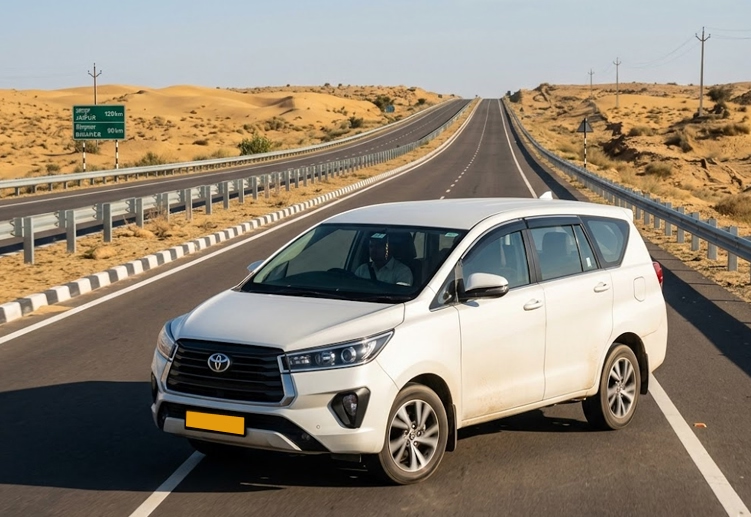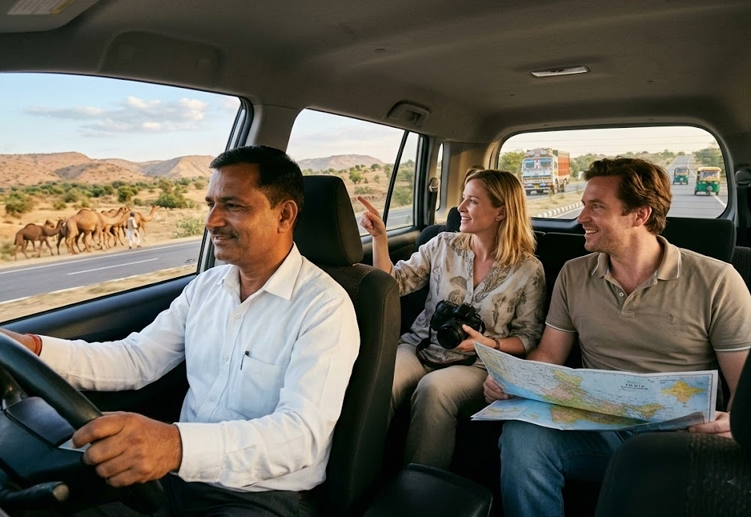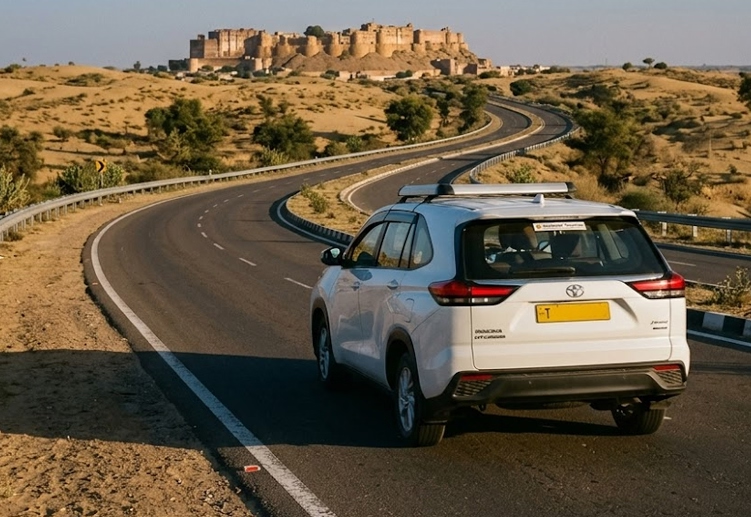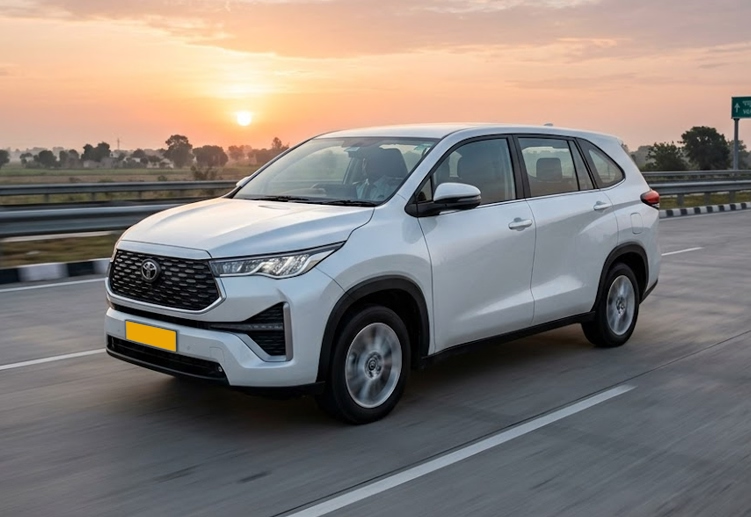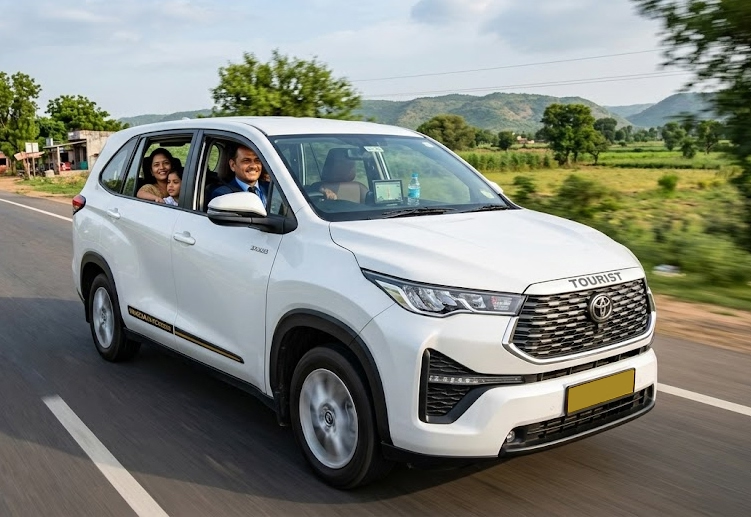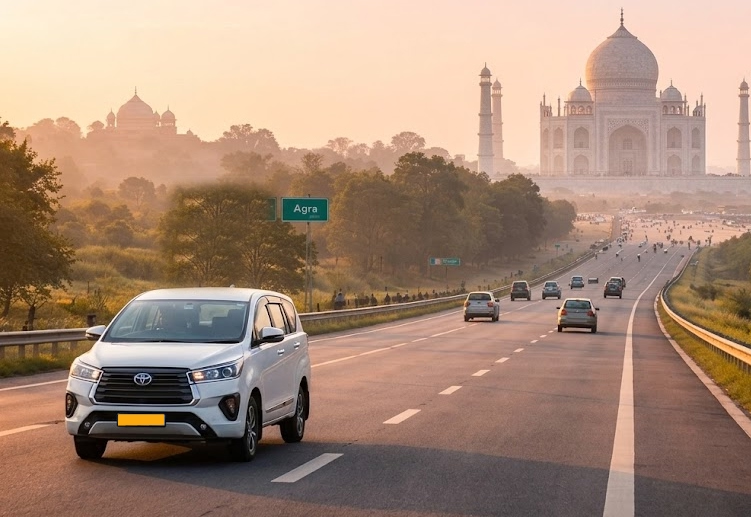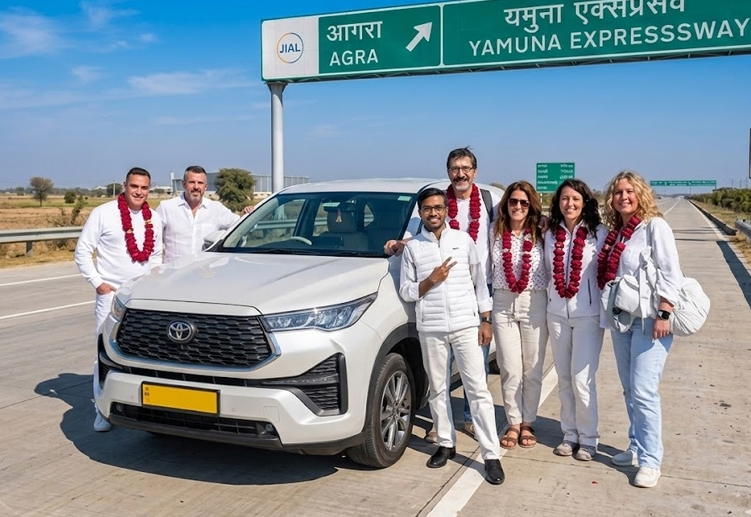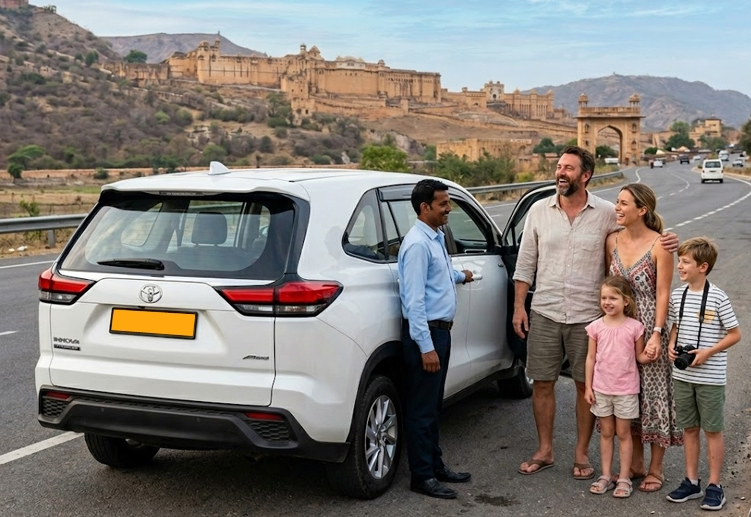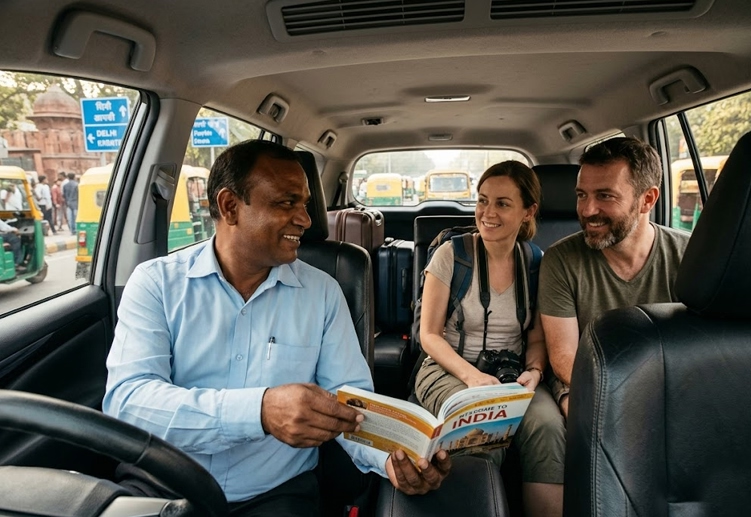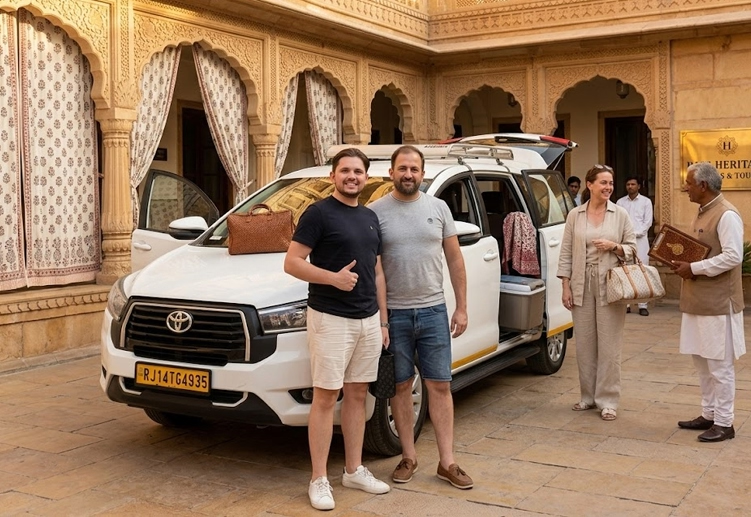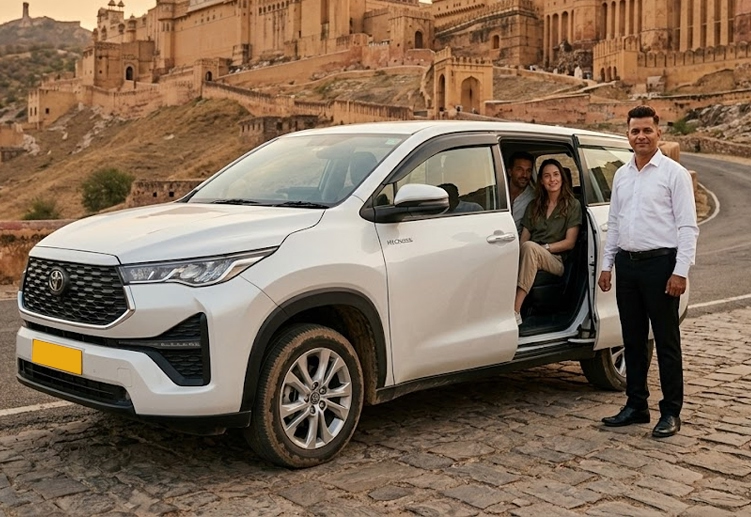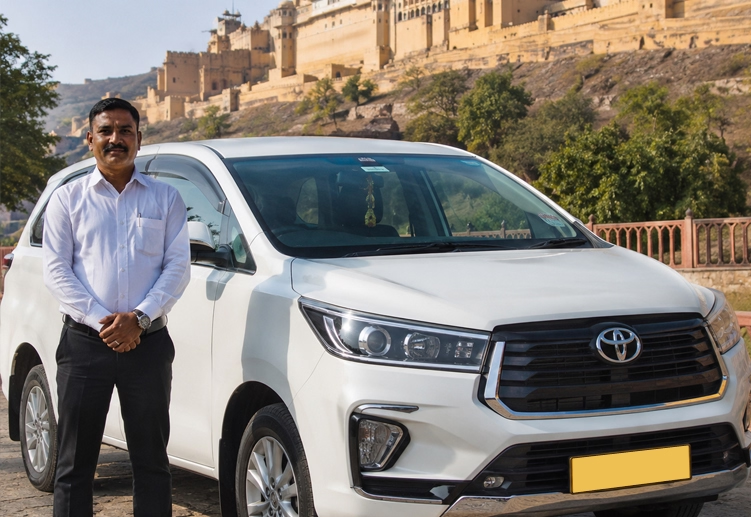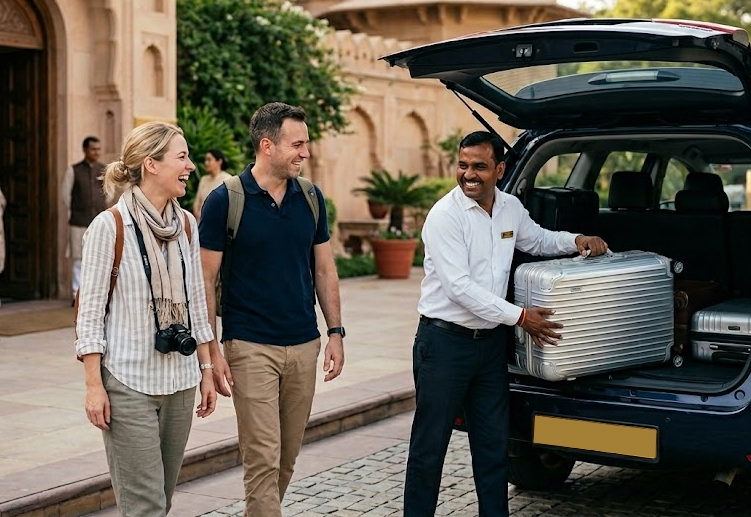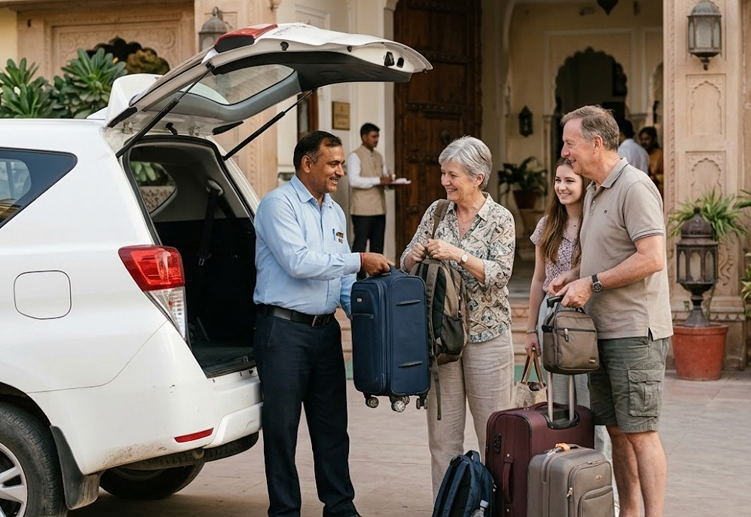


Planning India travel from the UK is exciting, but transport is one of the first things that can feel unfamiliar. India is huge, traffic works differently from Britain, train tickets can require advance planning and the distance between major sights is often greater than it appears on a map. For travellers who want to see several cities without constantly moving luggage between trains, taxis and airports, hiring a private car with a professional driver can make the journey considerably easier.
A private driver is particularly useful on routes such as Delhi-Agra-Jaipur, the classic Golden Triangle, and longer Rajasthan journeys through Pushkar, Jodhpur, Udaipur and Jaisalmer. Instead of arranging a different taxi every morning, the same car can collect you from your hotel, carry your luggage, take you between cities and remain available for planned sightseeing and transfers.
The important part is knowing what you are actually booking. Prices may be quoted per kilometre, per day or as one complete itinerary. Fuel may be included while tolls and parking are extra. A company may advertise a six-seat vehicle without explaining how little luggage space remains when every seat is occupied. Your driver may speak good conversational English but is not automatically a licensed sightseeing guide.
This guide is written specifically for travellers coming from Britain. It explains how to find and hire a reliable private driver in India, what a realistic chauffeur service should include, what cars are suitable for couples and families, how 2026 pricing usually works, which questions to ask before paying, how to arrange airport pickup, how much luggage matters, when to use guides as well as a driver, and how to avoid the booking mistakes that can turn an otherwise excellent India holiday into a stressful one.
- Best for first-time visitors: pre-book your driver before leaving the UK.
- Best route for a first road trip: Delhi-Agra-Jaipur.
- Best car for a couple: air-conditioned sedan with moderate luggage.
- Best comfort upgrade: Toyota Innova or Innova Crysta.
- Best for larger groups: Tempo Traveller or suitable minibus.
- Most important booking rule: compare the total tour price and inclusions, not just the cheapest per-kilometre figure.
Why UK Travellers Hire Private Drivers in India
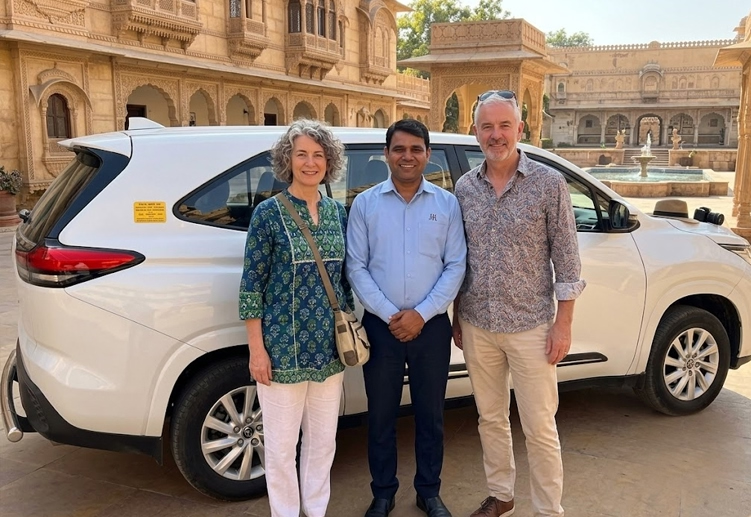
Britain is relatively compact. If you are accustomed to driving yourself around England or using frequent trains between major cities, it can take a little time to adjust to the scale and rhythm of travel in India. Delhi alone can involve long journeys between neighbourhoods, while a North India holiday may combine several cities hundreds of kilometres apart.
A private driver removes the daily work of navigating, finding parking, negotiating local taxis and deciding which road to take. You can leave a hotel in the morning, stop for lunch or photographs on the way and arrive directly at the next hotel without handling luggage at intermediate stations.
The benefit becomes most obvious on a multi-day tour. A Delhi airport taxi is easy to arrange independently. So is a single Jaipur sightseeing cab. The real value of a chauffeur appears when one vehicle connects the entire journey and the driver already knows where you are staying, what time you want to leave and where you are going next.
Is Hiring a Private Driver Normal in India?
Yes. Chauffeur-driven cars are a well-established form of travel in India. Domestic travellers, international tourists, business visitors and families regularly hire cars with drivers for city use and intercity journeys.
This is different from the British idea that having a chauffeur must be an extremely expensive luxury. India has a large commercial taxi and tourist-vehicle industry, so standard chauffeur-driven sedans can be relatively economical compared with the total cost of multiple transfers for two or more travellers.
There are, however, different levels of service. A basic outstation taxi primarily provides transport. A private touring driver normally understands multi-day tourism better, can coordinate hotel pickups, waits during sightseeing, assists with practical route decisions and remains with the trip across several cities. A high-end chauffeur service may add luxury vehicles, uniformed drivers and more formal support.
Private Driver, Taxi Driver and Tour Guide: The Difference
These roles are often mixed together online, which causes unnecessary confusion. A taxi driver takes you from one place to another. A private touring driver does that too, but normally works with an agreed multi-day itinerary and remains responsible for the vehicle throughout the trip.
A tour guide has a different job. A guide explains history, architecture, culture and monuments. In major destinations such as Delhi, Agra and Jaipur, you can book a qualified local guide for the sightseeing day while your driver handles transport and parking.
Some experienced drivers know a great deal about their region and can certainly help with practical information, restaurants, road stops and everyday life. That does not mean you should expect your driver to give the same detailed monument interpretation as a professional guide.
Quick Comparison: Private Driver vs Other Transport
| Transport | Best For | Main Advantage | Main Limitation |
|---|---|---|---|
| Private Driver | Multi-city road trips | Door-to-door flexibility | Costs more than the cheapest trains |
| Train | Selected long intercity sectors | Efficient on good rail routes | Fixed timetable and luggage transfers |
| Domestic Flight | Very long distances | Saves time across India | Airport time and baggage restrictions |
| Local Taxi/App Cab | Short city journeys | Useful on demand | Different driver each journey |
| Self-Drive | Experienced India drivers | Maximum independence | Navigation, traffic and parking responsibility |
Who Benefits Most from a Private Driver?
First-time visitors often gain the most because a driver removes one unfamiliar part of travelling in India. Couples can enjoy a flexible private itinerary without paying for a large group tour. Families avoid carrying bags and children repeatedly through railway stations. Senior travellers may appreciate direct hotel-to-hotel transfers and the freedom to stop whenever necessary.
A driver is also useful if photography, food or smaller destinations are important to you. A train only connects stations. A private car lets you stop at an interesting village, viewpoint or roadside restaurant when it fits the itinerary.
It is less necessary if you are visiting only Mumbai for four nights or spending an entire week in one resort. Private drivers are at their best when your holiday actually involves moving between destinations.
Entry Requirements Before Travelling from the UK
Transport planning should come after checking that your travel documents are in order. British citizens travelling on a full British citizen passport normally require an appropriate Indian visa unless they have qualifying Overseas Citizen of India status. India offers different visa categories, including electronic visas for eligible journeys, but you should always use the official Indian visa system rather than an unofficial website that simply resembles a government page.
Current UK government guidance states that a passport should have an expiry date at least six months after arrival in India and at least two blank pages. Foreign arrivals must also currently complete India's e-Arrival Card before immigration. Immigration procedures can change, so check official Indian immigration information and the latest GOV.UK India travel advice again shortly before departure rather than relying on a blog saved months earlier.
Also check travel insurance carefully. Your policy should cover the destinations and activities on your actual itinerary. UK government travel advice can contain warnings for particular parts of India, and travelling against official advice can affect insurance cover.
When Should You Book the Driver?
For a multi-day holiday, book before leaving Britain rather than waiting until you reach Delhi. You do not necessarily need to commit many months ahead, but arranging transport in advance gives you time to compare operators properly instead of making a rushed choice after a long flight.
For travel between October and March, Christmas and New Year, major Indian festivals and popular wedding periods, earlier booking is helpful if you specifically want an Innova Crysta, luxury car or larger Tempo Traveller.
A standard sedan is normally easier to source. A very specific vehicle, English-speaking touring driver or complicated fifteen-day Rajasthan itinerary deserves more notice.
How to Find a Reliable Private Driver in India
Start by looking for an established operator that clearly explains what it does. A useful website should show contact details, vehicle categories, destinations and enough information for you to understand whether the company regularly handles multi-day tourist journeys rather than only local taxi trips.
Then request a quote for a real itinerary. Do not begin by asking, "How much per kilometre?" Instead send your arrival date, airport, hotels or approximate cities, passenger count, luggage and final departure point. That lets the company calculate the correct vehicle and route.
Look at recent traveller feedback, but read the substance rather than only the rating. Reviews mentioning punctual airport pickups, long Rajasthan routes, clean cars, sensible driving and communication are more useful than a series of vague one-line comments.
What Information to Send When Requesting a Quote
- Your arrival date and flight details if airport pickup is required.
- The number of adults and children.
- The number of large suitcases and cabin bags.
- Your planned cities in order.
- Any confirmed hotels.
- Your final drop-off city, airport or railway station.
- Whether you want local sightseeing each day.
- Whether you need local guides.
- Any child-seat, mobility or accessibility requirements.
- Your preferred vehicle category if you already have one.
A Good Quote Should Be Easy to Understand
A private-driver quotation should not require you to solve a complicated spreadsheet. For a complete itinerary, one total figure with clearly stated inclusions is usually easier for an international traveller than several unexplained per-kilometre numbers.
If the operator uses per-kilometre pricing, ask how the kilometre count works. Some outstation bookings have a minimum number of billable kilometres each day. Others calculate distance from the operator's garage rather than your hotel. Driver allowance, tolls, parking, state taxes and GST may be separate.
None of those arrangements is automatically wrong. The problem is discovering them after the tour has begun. Written clarity matters more than which pricing model is used.
How Much Does a Private Driver Cost in India in 2026?
There is no single national chauffeur tariff. Rates vary by city, vehicle, season, route and what the price includes. Still, current published 2026 market examples provide useful planning ranges.
Standard chauffeur-driven sedans are frequently advertised around ₹11-₹12 per kilometre for outstation journeys. Ertiga-type vehicles commonly appear around ₹13-₹15 per kilometre, while Toyota Innova and Innova Crysta rates often sit around ₹16-₹19 per kilometre. A Tempo Traveller can begin around the mid-?20s per kilometre depending on size and configuration.
These figures should be treated as comparison points, not promised prices. A quote that includes fuel, tolls and driver allowance cannot be compared directly with a lower rate that excludes them.
| Vehicle | Best For | Useful 2026 Planning Range* | Comfort Level |
|---|---|---|---|
| Sedan | Solo traveller / couple | ₹11-₹12/km | Good |
| Ertiga / Similar | Small family / 3-4 travellers | ₹13-₹15/km | Good to very good |
| Innova / Crysta | Families / comfort-focused travellers | ₹16-₹19/km | Very good |
| Tempo Traveller | Larger groups | ₹24-₹30/km | Depends on configuration |
*Indicative published market examples for planning only. Your total will depend on the route, number of days, minimum kilometres, tolls, parking, driver allowance, taxes and vehicle availability.
Why You Should Not Convert Every Quote into Pounds Immediately
It is natural for UK travellers to convert every rupee price into pounds while comparing options. That helps with your holiday budget, but exchange rates move and your bank or card provider may use a different rate from the one shown on a search engine.
Compare Indian operators in rupees first. Make sure both quotations cover the same number of days, same route, same vehicle category and same inclusions. After you know which Indian price is genuinely better, convert the total into sterling for your personal budget.
This prevents a small exchange-rate movement from distracting you from a much bigger difference such as tolls being excluded or an inferior vehicle being supplied.
Per-Kilometre Pricing Explained
Outstation chauffeur bookings in India commonly use a kilometre-based rate. If your sedan is ₹12 per kilometre, that does not necessarily mean you simply multiply the visible Google Maps route by ₹12.
The provider may apply a minimum daily distance, sometimes around 250 kilometres. There can also be rules about where mileage starts and finishes. A seven-day Rajasthan tour that looks like 1,200 kilometres on your itinerary can therefore have a higher billable distance.
For a UK visitor, the easiest solution is to give the operator the full itinerary and ask for a complete tour cost. If they still quote by kilometre, request an estimated total based on the planned route.
Driver Allowance and Night Halt
On a multi-day road trip, the driver also stays away from home. Some companies include the driver's daily allowance and night halt in your package. Others add a fixed amount per day or night.
You normally do not need to book your driver into your own hotel room. Tourist drivers and operators have established arrangements for driver accommodation. If your hotel provides driver accommodation, that may also be used.
Ask one simple question before booking: "Is all driver allowance and overnight accommodation included in my quoted total?" A yes in writing removes uncertainty later.
Fuel, Toll Roads, Parking and State Taxes
Fuel is commonly included in a chauffeur rate, but do not assume it. Toll roads are widely used between major North Indian cities, including important parts of Golden Triangle itineraries. Parking charges can arise at monuments, hotels and city attractions.
Interstate road taxes or permits can also matter on routes crossing state boundaries. Your operator should handle the administrative side of legal commercial road travel; you simply need to understand whether those costs are already included in your package.
A slightly more expensive all-inclusive quote can be better value than a cheap headline price followed by several days of paying extras.
Choose the Car by Luggage, Not Just Passenger Count
This is one of the biggest differences between a short taxi ride and a private India tour. On a taxi journey from Heathrow, you only need the bags to fit for an hour. On an India road trip, those suitcases move from Delhi to Agra, Jaipur and every later hotel with you.
A sedan is excellent for two people with normal luggage. It becomes much less attractive when two travellers each have a large suitcase, a cabin trolley, backpacks, camera equipment and shopping bags.
Likewise, a vehicle advertised as carrying six passengers may technically have six passenger seats but very little boot space when all are occupied. Send the operator an honest luggage count before booking.
Sedan: Best Value for One or Two UK Travellers
A standard air-conditioned sedan such as a Dzire, Aura, Etios or equivalent is normally the best-value private-driver vehicle for a solo traveller or couple. It is economical, comfortable on mainstream highways and easy to manoeuvre through city traffic.
You do not need an SUV simply because you are taking a road trip in India. Delhi, Agra, Jaipur, Pushkar, Jodhpur and Udaipur are connected by ordinary roads suitable for normal passenger cars.
For two adults carrying one medium or large suitcase each plus hand luggage, a sedan is usually sufficient. If you are travelling for several weeks with oversized cases, upgrading can make the daily experience more comfortable.
Ertiga: A Useful Middle Option
An Ertiga or similar multi-purpose vehicle sits between the sedan and Innova. It works particularly well for a small family or three to four travellers who want more cabin flexibility without paying the full Innova Crysta rate.
The important issue is the third row. When all rear seats are occupied, the remaining luggage space can be limited. If there are four adults with four large international suitcases, ask the provider directly whether the proposed configuration will work.
Do not be embarrassed to send luggage dimensions or even a photograph of your cases. Solving the problem before arrival is much easier than discovering at Delhi airport that bags have to be squeezed between passengers.
Innova Crysta: The Popular Comfort Upgrade
For families, three to five travellers, longer routes or people who value additional cabin room, an Innova or Innova Crysta is one of the most practical touring vehicles in India. It offers more flexible seating and generally makes repeated long road sectors easier.
A couple does not automatically need one. If two people are travelling Delhi-Agra-Jaipur for six days with moderate luggage, a sedan can be perfectly comfortable. But if the same couple is continuing for two weeks through Rajasthan, carrying several bags and spending many more hours on the road, the upgrade becomes easier to justify.
For four adults with international luggage, an Innova-class vehicle is normally a much stronger choice than trying to save money with a sedan.
Tempo Traveller for Groups
Groups should resist the temptation to squeeze into the maximum advertised capacity of an Innova. Six adults plus six large suitcases can create an uncomfortable touring setup even when the seat count looks acceptable on paper.
A Tempo Traveller can keep a family group or group of friends together while providing a more suitable seating arrangement. Different versions have different luggage configurations, so ask whether bags are stored in a dedicated rear area, inside the cabin or elsewhere.
For seven or more travellers, one suitable group vehicle can also simplify hotel departures compared with coordinating two separate cars every morning.
Do You Need a Luxury SUV?
Usually not. A Fortuner or luxury SUV can be enjoyable if you want the vehicle itself to feel premium, but mainstream tourist routes do not require an off-road vehicle.
Premium SUVs can cost considerably more than an Innova without providing a proportionate increase in luggage practicality. If comfort is the goal, compare the actual rear seating and storage rather than choosing by badge.
Luxury vehicles make the most sense for VIP travel, business visitors, weddings, anniversaries and travellers who simply enjoy a particular style of car.
Vehicle Comparison for UK Travellers
| Your Group | Recommended Vehicle | Why |
|---|---|---|
| 1 traveller | Sedan | Plenty of space and lowest practical cost |
| 2 travellers + normal luggage | Sedan | Excellent value |
| 2 travellers + several large bags | Innova / Ertiga | More luggage flexibility |
| 3 adults | Ertiga / Innova | More comfortable on longer routes |
| 4 adults + luggage | Innova Crysta | Better cabin and baggage arrangement |
| 5-6 travellers | Innova or Tempo Traveller | Depends on luggage volume |
| 7+ travellers | Tempo Traveller | Better group configuration |
Check That the Vehicle Is a Proper Commercial Tourist Vehicle
When booking through a professional chauffeur operator, the car should be appropriately registered and permitted for commercial passenger or tourist use. India has permit systems for commercial taxis and tourist vehicles, including arrangements that allow authorised vehicles to operate across state boundaries.
You do not need to become an expert on Indian transport regulations before your holiday. You do, however, want to avoid an informal arrangement where someone is simply using an ordinary private vehicle commercially without appropriate documentation.
Ask whether the vehicle is commercially registered and insured for passenger transport. A professional operator should not find that question unusual.
Ask for the Actual Vehicle Category
Online phrases such as "SUV", "luxury SUV" and "premium car" are not always used consistently. One website may call an Ertiga an SUV, another may categorise an Innova as an SUV, and a third may reserve the term for a Fortuner.
Ask for the actual proposed model or at least a clear equivalent category. If you specifically pay for an Innova Crysta, confirm whether an older Innova or another vehicle can be substituted.
Reasonable substitutions sometimes happen because vehicles need maintenance or a previous booking is delayed. What matters is that you know the policy before payment.
Ask for Recent Car Photographs When Appearance Matters
You do not need a professional photoshoot of the exact car for every standard booking, but recent pictures can be useful when you are booking a premium model or care strongly about vehicle condition.
Remember that a photograph alone tells you little about mechanical maintenance. Clean upholstery looks good online, but reliable air-conditioning, tyres, seat belts, suspension and professional driving matter far more during a 300-kilometre travel day.
Judge the entire operator rather than a single attractive vehicle image.
English-Speaking Driver: What Should You Expect?
For travellers from Britain, practical English communication makes the journey much easier. Your driver does not need formal or perfect English. What matters is whether you can comfortably discuss departure times, restaurants, rest stops, hotel names, itinerary changes and basic problems.
When contacting the operator, ask specifically for a driver with conversational English experience with international travellers. You can also make a short phone or WhatsApp call before finalising a long booking if communication is particularly important to you.
Keep complicated instructions simple and confirm important timings in a written message. That works well in any international travel situation.
Airport Pickup in Delhi
Delhi is a common arrival point from the UK and one of the most useful places to begin a chauffeur-driven North India trip. After a long overnight flight, having a confirmed airport pickup saves you from making transport decisions immediately after immigration and baggage collection.
Send your flight number rather than only an estimated arrival time. The operator can monitor schedule changes more effectively and agree on a meeting point at the terminal.
Save the company and driver's WhatsApp numbers before leaving Britain. Airport Wi-Fi and mobile roaming are normally available, but having all contact details stored offline removes unnecessary stress.
Should You Drive Straight to Agra After Landing?
It depends on your flight time and how well you handle overnight travel. Agra can be reached by road from Delhi, and some visitors prefer leaving the capital immediately. However, landing after an overnight UK flight, completing immigration and then spending several more hours on the road can be tiring.
If your itinerary allows it, spending the first night in Delhi can create a gentler start. You can sleep properly, begin sightseeing the following morning and travel to Agra later.
If you do drive onward on arrival day, tell your driver and operator the flight details and avoid constructing a schedule that depends on an exact immigration completion time.
The Golden Triangle: Best First Private-Driver Route
Delhi, Agra and Jaipur form the classic Golden Triangle and are ideal for a first chauffeur-driven holiday. The cities are different enough to make the route interesting while being connected in a logical circuit.
Delhi offers Mughal and colonial history alongside modern neighbourhoods. Agra provides the Taj Mahal, Agra Fort and access to Fatehpur Sikri. Jaipur brings forts, palaces, bazaars and Rajasthan into the journey.
A private car lets you keep the same luggage setup from the first Delhi hotel until Jaipur. You can also stop at Fatehpur Sikri between Agra and Jaipur instead of treating it as a separate excursion.
How Many Days for Delhi, Agra and Jaipur?
Five days is possible but busy. Six or seven days is more comfortable for most first-time travellers, particularly after flying from Britain. A slower itinerary gives you time to recover from the journey, spend a proper day sightseeing in each city and avoid turning every morning into an early departure.
A typical pattern might include two nights in Delhi, one or two in Agra and two in Jaipur. Travellers who enjoy slower sightseeing can add another night rather than constantly adding new destinations.
A private driver provides flexibility, but it cannot make geographical distances disappear. Building enough time into the itinerary is still important.
Delhi to Agra with a Private Driver
Delhi to Agra is one of the most straightforward road sectors for international visitors and is commonly driven using the Yamuna Expressway. A normal sedan handles the journey comfortably, so there is no need to pay for an SUV because of road conditions.
The exact travel time depends on your starting neighbourhood in Delhi, traffic, breaks and the location of your Agra hotel. Delhi itself can add considerable time before you even reach the expressway.
If you plan to see the Taj Mahal on arrival day, leave enough margin. A relaxed overnight stay is often better than building a monument ticket around an optimistic road arrival estimate.
Agra to Jaipur with Fatehpur Sikri
The road from Agra toward Jaipur creates one of the best opportunities to use the flexibility of a private car. Fatehpur Sikri lies naturally on this travel day and can be incorporated into the journey rather than requiring you to return to Agra afterwards.
Your touring luggage normally remains in the locked vehicle while you visit the site, but carry passports, cash, medication, phones, cameras and other valuables with you.
Do not overload the same day with too many extra stops. The point of a private driver is freedom, not a race to collect as many attractions as possible.
Extending the Journey into Rajasthan
Once you reach Jaipur, a private driver becomes even more valuable if the trip continues through Rajasthan. Pushkar, Jodhpur and Udaipur combine naturally in a road itinerary, while Jaisalmer can be added when you have enough extra time for the longer distances involved.
For a couple, this is where upgrading from a sedan to an Innova can become attractive. A Golden Triangle involves two main intercity road days. A longer Rajasthan circuit can involve many more hours in the same seat.
See our Rajasthan tour packages if you want ideas for extending the route beyond Jaipur.
A Practical 10-Day Private-Driver Route
| Day | Route | Plan |
|---|---|---|
| 1 | Delhi | Airport pickup and rest |
| 2 | Delhi | Old and New Delhi sightseeing |
| 3 | Delhi-Agra | Drive to Agra and local sightseeing |
| 4 | Agra-Jaipur | Taj Mahal, Fatehpur Sikri and onward drive |
| 5 | Jaipur | Full Jaipur sightseeing |
| 6 | Jaipur-Pushkar | Relaxed transfer and Pushkar |
| 7 | Pushkar-Jodhpur | Drive to Jodhpur |
| 8 | Jodhpur | Mehrangarh Fort and city |
| 9 | Jodhpur-Udaipur | Road journey with optional stop en route |
| 10 | Udaipur | City sightseeing or onward departure |
This is only an example. A strong private itinerary should match your arrival flight, interests and preferred pace rather than forcing every traveller into the same route.
Private Driver vs Train for UK Visitors
India's railway network is part of the travel experience and trains can be excellent for specific journeys. The choice is not necessarily driver or train for the entire holiday. You can combine them.
A train makes sense when it saves significant road time or provides an experience you specifically want. A private driver makes sense when you want hotel-to-hotel movement, intermediate sightseeing or a route involving places not conveniently linked by direct trains.
For the Golden Triangle and Rajasthan, many couples prefer the continuity of one chauffeur because they do not have to carry luggage through stations every few days.
Private Driver vs Domestic Flights
India is far too large to drive everywhere on one normal holiday. If you want to combine Rajasthan with Kerala, Goa or another distant region, flying between regions is usually more sensible than keeping one car across the entire country.
A good itinerary might use a private driver for Delhi-Agra-Jaipur-Udaipur, then a flight to Mumbai or Kochi and a new local arrangement in the next region.
Think regionally. A chauffeur is excellent for connected destinations; aircraft are better for crossing very large distances.
Private Driver vs Self-Drive in India
British travellers are accustomed to driving on the left, which India also does, but that does not make the road environment identical. Traffic density, lane behaviour, junctions, pedestrians, motorcycles, animals and local driving conventions can be considerably more demanding than those most visitors know at home.
Hiring a driver means you can concentrate on the country rather than navigation and parking. It also removes the administrative questions around self-drive rental requirements and vehicle deposits.
If you are deciding between the two, read our car rental with driver vs self-drive India guide.
Best Time to Visit India from the UK
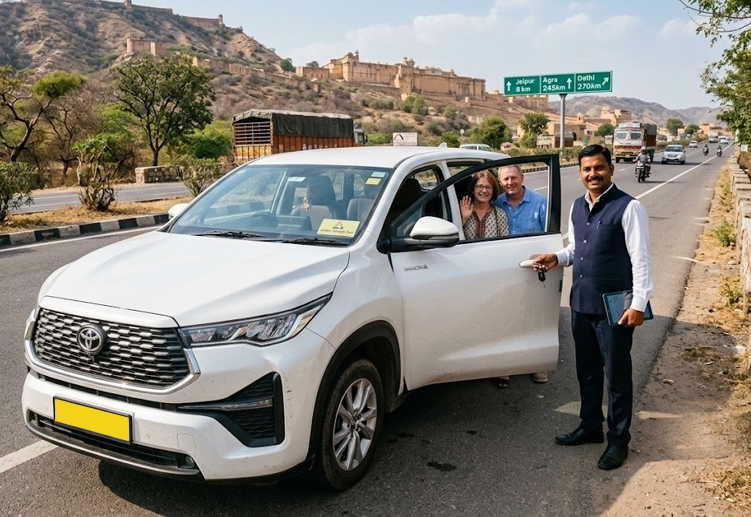
The ideal season depends on the region, but October through March is particularly popular for Delhi, Agra and Rajasthan because sightseeing temperatures are generally more comfortable than during the hottest months.
December and January can bring cool mornings and evenings in North India. Travellers sometimes arrive expecting constant tropical heat and are surprised to need a jacket early in the day. Fog can also affect roads and flights in parts of North India during winter.
April, May and June can be extremely hot in many northern cities. A properly functioning air-conditioned vehicle becomes particularly important. Monsoon conditions vary by region and month, so plan according to the actual destinations rather than thinking of India as having one national climate.
How Weather Affects Driving Days
Do not plan Indian road journeys as though every map estimate is guaranteed. Heavy rain, fog, local traffic, roadworks and city congestion can all change travel times.
Winter fog is especially relevant when travelling in parts of North India. If you have a flight from Delhi, avoid scheduling a long intercity drive that is supposed to reach the airport shortly before check-in closes.
A private driver gives flexibility during ordinary delays, but the safest itinerary still includes sensible buffers around important flights and trains.
Air-Conditioning Is Essential
Ask for an air-conditioned vehicle even if you travel during the cooler tourist season. Afternoon temperatures can still rise, and city pollution or road dust sometimes means you will prefer the windows closed.
For an Innova or larger vehicle, rear air-conditioning matters more than a premium badge. A well-maintained standard vehicle with strong cooling can provide a better journey than an older luxury vehicle with weak AC.
If the cooling does not work properly at the beginning of a long summer tour, raise the issue immediately rather than hoping it will improve over the next several days.
Seat Belts and Vehicle Safety
Use a seat belt whenever one is provided and make this part of your vehicle check at the start. If you are travelling with children and require a particular restraint, discuss it before arrival rather than assuming that the fleet automatically carries British-style child seats.
Check whether the operator can arrange an appropriate child seat and whether it can be correctly fitted to the proposed car. Travellers who prefer to bring their own restraint should confirm compatibility and airline baggage arrangements.
Vehicle condition and driving style are both more important than cosmetic luxury.
What Is a Good Driving Style?
A professional tourist driver should drive smoothly, avoid unnecessary speeding and remain focused on the road. If you feel uncomfortable with the speed, say so early and clearly. There is nothing unreasonable about asking for a relaxed journey.
Do not encourage the driver to make up time after you have left late. It is better to shorten a sightseeing stop than turn the next highway sector into a race.
The quality of a chauffeur service is not measured by how quickly it reaches Jaipur. It is measured by safe, reliable and comfortable travel over the entire itinerary.
Avoid Unnecessary Overnight Driving
For ordinary sightseeing holidays, daytime road travel is usually preferable. You can see the landscape, stop for meals naturally and arrive at hotels at a reasonable hour.
Occasional early starts may make sense for flights or special plans, but there is little benefit in designing an itinerary filled with late-night intercity journeys simply to fit another monument into the schedule.
When comparing itineraries, choose the one that treats travel time as part of the holiday rather than dead time that must always be compressed.
Food and Rest Stops on the Road
One pleasure of travelling with a private driver is being able to stop when you need a break. On major intercity routes, your driver can normally suggest established roadside restaurants or service areas.
If you want a particular style of food, say so. You are not required to eat at whichever restaurant the driver happens to mention first. A professional driver should be comfortable with you choosing another suitable option.
Carry drinking water and a few simple snacks on longer road days, particularly when travelling with children.
Shopping Stops and Commission Pressure
Tourism-related shopping commissions exist in many countries, including India. A driver or guide may suggest a textile shop, jewellery showroom, marble workshop or handicraft store. That can be genuinely interesting when you want to shop, but it should remain your choice.
If shopping is not part of your holiday, say politely and clearly at the beginning that you prefer no commercial stops unless you request them.
When selecting an operator, traveller reviews that specifically mention "no pressure to shop" can be useful evidence of service style.
Tipping Your Private Driver
Tipping is discretionary and should reflect the quality and length of service rather than feeling like a compulsory hidden charge. For a multi-day journey, travellers often prefer giving one tip at the end instead of handing over money every evening.
The appropriate amount depends on group size, duration and service. Ask your tour company for current guidance if you want a reference point, then use your own judgement.
A gratuity should reward good service. It should not replace a properly agreed salary or become an unexplained mandatory fee added to the bill.
Cash, Cards and Paying the Driver
Agree on the payment method before the tour. Some operators take a deposit electronically and the balance in India. Others accept bank transfer, cards, cash or combinations of these.
Do not assume that your individual driver will personally accept an international credit card. The driver and the company may handle payments separately.
Keep receipts or written confirmation for larger payments and avoid carrying more cash than you realistically need. UK-issued cards are widely useful in major cities, although small local purchases may still be easier with cash or locally supported payment methods.
Should You Pay the Entire Tour in Advance?
Payment policies vary. A deposit is normal for many confirmed bookings, particularly when a company is reserving a specific vehicle for a long itinerary.
Before making a substantial advance payment, make sure you have the business details, itinerary, vehicle category, cancellation terms and total price in writing. Understand when the balance is due and what happens if your flight changes or you cancel.
A remarkably cheap offer requiring urgent full payment through an unusual channel deserves more scrutiny than a professionally documented booking.
WhatsApp Is Extremely Useful
WhatsApp is widely used for tourism communication in India and works well for driver contact. Save the company number and driver number before departure. You can send hotel locations, flight updates and simple itinerary messages without worrying about pronunciation or spelling.
Ask the operator to send the driver's name and number before your arrival. You can also request the vehicle registration number when the allocation is final.
Keep screenshots of the important information offline in case mobile data is temporarily unavailable.
Buying an Indian SIM or eSIM
Having mobile data makes a private-driver trip easier because you can message hotels, check maps, verify opening times and contact your operator. International roaming from a UK network may be convenient but can be expensive depending on your plan.
Before departure, compare your network's India roaming package with available travel eSIM options. Travellers staying longer can also investigate local SIM arrangements after arrival.
You do not need constant connectivity to use a private driver, but reliable messaging makes small changes much easier.
Share Your Hotel Details in Advance
Hotel names can be surprisingly similar, particularly when chains have several branches in one city. Send the full property name and address or map location rather than typing only "Radisson Jaipur" or another incomplete reference.
If hotels change during the planning process, update your driver or operator before the relevant travel day. Do not assume a reservation change made with the hotel automatically reaches the chauffeur company.
A simple final itinerary with dates and hotel names is enough to keep everyone aligned.
Do Not Overplan Every Minute
One reason to pay for private transport is freedom. If you create a minute-by-minute schedule that allows no flexibility, you remove much of that benefit yourself.
Plan major sights and any timed tickets, then leave reasonable breathing room for lunch, photographs, unexpected traffic and moments when you simply want to stay somewhere longer.
India rewards curiosity. A ten-minute tea stop or an unplanned viewpoint can become more memorable than rushing through an additional attraction because it appeared on a checklist.
Driver Hours and Very Long Sightseeing Days
A private driver should not be treated as an unlimited 24-hour transport resource simply because you have booked the car for several days. Professional operators need sensible working arrangements for drivers.
If you plan an unusually early departure followed by a late-night event, discuss it in advance. The company may need to adjust the schedule, arrange another local transfer or account for additional driver requirements.
Rested drivers are part of safe travel. Build your itinerary accordingly.
What Happens When You Use a Local Guide?
The driver normally drops you at an appropriate meeting point for the guide and then moves or parks the vehicle while you visit the monument. After sightseeing, the guide and driver coordinate the pickup location.
This works particularly well in Delhi, Agra and Jaipur, where major monuments have specific access and parking patterns.
You can use a guide for a full day, selected monuments or not at all. The driver remains your transport connection regardless.
Why a Driver Should Not Control Your Itinerary
A good driver can make helpful suggestions when traffic, road closures or local timings require adjustment. That is different from changing your holiday for their convenience.
Your route should reflect what you want to see. If you have booked Jaipur City Palace, you should not mysteriously find yourself taken to three shops instead because those are easier for someone else.
Share the agreed itinerary with both the company and driver. Flexibility should work in your favour.
Travelling as a Couple
For two people, private-driver travel can provide an appealing middle ground between independent backpacking and a fully escorted group tour. You still choose your hotels, restaurants and pace, but the hardest transport decisions disappear.
A sedan is normally enough, which keeps the cost reasonable. You can upgrade selected elements of the holiday - perhaps a better hotel in Udaipur or a private guide at the Taj Mahal - rather than spending unnecessarily on a huge car.
Couples planning a long Rajasthan itinerary may still appreciate the additional cabin space of an Innova.
Travelling with Children
Families gain enormously from having their own car because snacks, jackets, day bags and other small items can remain organised between stops. Children also get a familiar vehicle each day instead of constantly entering different taxis.
Build shorter sightseeing days than you might for adults only. Long road sectors are easier when there is time for regular breaks.
Discuss child restraints in advance and remember that a vehicle with enough seats may still lack enough luggage space once strollers and family baggage are added.
Travelling with Senior Family Members
A private car can reduce walking associated with railway transfers and make hotel-to-hotel journeys more manageable. An Innova-class vehicle may provide useful extra cabin room, but check the step-in height if mobility is limited.
A very tall SUV is not automatically easier to enter. The best vehicle depends on the individual traveller.
Tell the operator about significant practical mobility requirements so they can recommend the most appropriate car rather than simply sending their most expensive model.
Solo Travel with a Private Driver
Solo travellers sometimes assume a private driver is only for couples or families. It can still make sense if comfort, photography, a complicated route or avoiding repeated transport negotiations matters more than having the lowest possible daily budget.
Check the company carefully, share your itinerary with someone at home and keep normal travel-safety practices. For solo women travellers, review current destination-specific guidance and choose accommodation and transport providers with a strong track record among international guests.
A sedan is normally more than enough for one traveller.
Female Travellers and Practical Safety
Women travel independently across India, but sensible planning matters. Book a reputable operator, confirm who is meeting you at the airport and avoid accepting an unexpected replacement driver without checking with the company.
Share your itinerary with family or friends and use the same common-sense precautions you would apply elsewhere: keep control of your passport and money, know where you are staying and speak up if a situation makes you uncomfortable.
UK travellers should also read the current FCDO guidance for women travellers and the destinations on their itinerary before departure.
Keep Passports and Valuables with You
Your main suitcase can normally remain in the locked touring vehicle during a sightseeing stop on an intercity day. Passports, wallets, medication, jewellery, important electronics and irreplaceable documents should stay with you.
A small cross-body bag or day backpack makes this easy. Do not repeatedly unpack your large luggage at roadside stops just to retrieve essential items.
Organising your luggage into "touring suitcase" and "daily valuables bag" is one of the simplest ways to make a chauffeur trip smoother.
What If the Vehicle Breaks Down?
Mechanical problems can happen anywhere. What separates a good operator from a poor one is the response.
Ask before booking what happens if the vehicle cannot continue. An established company should have a process for repair or replacement, particularly on common tourist routes.
If you have a flight, train or other fixed commitment, notify the operator so they understand the urgency. Do not accept vague promises that breakdowns are "impossible". No vehicle is immune from mechanical failure.
What If Your Flight from the UK Is Delayed?
Send your actual flight number when booking airport pickup. If the airline changes the schedule before departure, message the operator when you know.
A professional airport-transfer service should understand that international arrival times can move. Clarify whether waiting is included and what happens in the event of a very substantial delay or cancellation.
When your entire road trip starts with the same operator, keeping them updated from the beginning prevents the first-day problem from affecting the rest of the itinerary.
What If You Want to Change the Route During the Tour?
Small changes are one of the advantages of a private driver. If you decide to spend an extra hour in Jaipur or skip an attraction, that is usually easy.
Larger changes can affect the cost. Adding a new city, extra overnight stay or several hundred kilometres is no longer a minor adjustment. Ask the operator for any revised price before making the change.
This keeps the flexibility enjoyable rather than creating an argument about the final bill.
How to Compare Two Driver Quotes Properly
Give both companies exactly the same itinerary and passenger information. Then compare vehicle, number of days, billable kilometres and inclusions line by line.
A ₹12/km sedan with fuel and tolls included may be cheaper overall than a ₹10/km offer with several extras. Similarly, an Innova Crysta quote should not be compared with an Ertiga quote as though they are the same product.
Customer support matters too. Saving a small amount is rarely worthwhile if communication is poor before you have even paid.
| Check | Quote A | Quote B |
|---|---|---|
| Vehicle model/category | Confirm | Confirm |
| Fuel | Included/extra? | Included/extra? |
| Tolls | Included/extra? | Included/extra? |
| Parking | Included/extra? | Included/extra? |
| Driver allowance | Included/extra? | Included/extra? |
| State taxes | Included/extra? | Included/extra? |
| GST | Included/extra? | Included/extra? |
| Minimum kilometres | Confirm | Confirm |
| Breakdown support | Confirm | Confirm |
Red Flags When Hiring a Private Driver
No clear total price. If every answer produces another unexplained fee, do not rush to pay.
No vehicle clarity. "Luxury SUV" means little without a model or genuine category.
Pressure for immediate payment. A legitimate peak-season booking may require a deposit, but artificial urgency deserves caution.
No company or operator details. You should know who is actually responsible for your multi-day booking.
Refusal to discuss commercial vehicle status. Tourist transport should be appropriately registered.
Promises that sound impossible. Unrealistically short driving times and guaranteed access to every attraction are not signs of professionalism.
Repeated pressure to visit shops. Your sightseeing priorities should come first.
Common Mistakes UK Travellers Make
Booking the smallest possible car. UK travellers often arrive with larger luggage than domestic taxi passengers. Allow room for your cases.
Trying to see too much. India looks manageable when itinerary cities are written in a list. Road distance changes the experience.
Choosing on price alone. The driver is part of your holiday for many days. Communication and reliability matter.
Assuming driver means guide. Book professional guides separately when detailed interpretation matters.
Putting a flight immediately after a long road sector. Traffic and weather deserve a buffer.
Forgetting to check visa and entry rules shortly before departure. Immigration requirements can change.
Questions to Ask Before Paying a Deposit
- What exact vehicle or vehicle category am I booking?
- Will my passenger and luggage combination fit comfortably?
- Is the vehicle air-conditioned?
- Is it commercially registered for tourist/passenger transport?
- Does the driver have experience with international travellers?
- Can you provide an English-speaking driver?
- What is the complete tour price?
- Are fuel, tolls and parking included?
- Are state taxes and driver allowance included?
- Does a daily minimum kilometre charge apply?
- Where does kilometre counting begin and end?
- What happens if the vehicle has a mechanical problem?
- What is the cancellation policy?
- When is the remaining balance due?
- Will I receive the driver and vehicle details before arrival?
A Simple Booking Process from the UK
First, decide your cities and approximate nights. You do not need every restaurant and monument finalised.
Second, send the route, travel dates, passenger count and luggage to two or three reputable operators.
Third, compare the complete written quotations rather than only the headline rate.
Fourth, confirm the vehicle, inclusions, airport pickup, cancellation policy and payment schedule.
Fifth, pay the agreed deposit using the documented method and keep confirmation.
Finally, a few days before travelling, reconfirm your flight, first hotel, pickup point and emergency contact details.
Preparing for Arrival Day
Keep your Indian visa or OCI documentation, passport and required arrival information ready for immigration. Complete current arrival forms required by Indian authorities before reaching immigration according to the official instructions in force when you travel.
Keep the driver's contact number in your phone and separately in a screenshot. After collecting baggage, connect to mobile data or airport Wi-Fi if necessary and message the driver.
Do not panic if the terminal is crowded. Confirm the agreed meeting point and only get into the vehicle associated with your booking.
How Much Luggage Should You Bring?
A private car removes many luggage difficulties, but travelling lighter still makes an India holiday easier. Hotel changes happen frequently on road trips, and every large suitcase must be loaded and unloaded repeatedly.
For a couple using a sedan, two standard checked bags plus smaller cabin luggage is a much easier arrangement than several oversized cases.
Remember that you may buy textiles, crafts or souvenirs in Jaipur and other Rajasthan destinations. Leave some spare capacity instead of arriving with every bag completely full.
Laundry Can Reduce Your Luggage
Many Indian hotels offer laundry services, and independent laundry options are also available in tourist cities. On a two-week itinerary, using laundry once or twice can reduce how much clothing you need to carry from Britain.
This matters more than it sounds because less luggage can allow a couple to use a sedan rather than upgrading purely for boot capacity.
Keep delicate or expensive items separate and check hotel laundry pricing and turnaround times before handing anything over.
What to Keep in the Car During Road Days
A small day bag can hold water, tissues, hand sanitiser, a light layer, sunglasses, sunscreen, charging cable and any medication you need during the journey. Keep passports and valuables in the bag rather than in your large suitcase.
If you travel during winter in North India, a light jacket may be useful for early starts. In hotter months, sun protection and water become more important.
A compact power bank is useful even when the car has charging ports.
Food, Water and Health Planning
Use bottled or appropriately filtered drinking water and follow sensible food hygiene. Your driver can suggest established restaurants on common routes, but make your own judgement about where you eat.
If you have food allergies, carry a written explanation of the ingredients you must avoid and discuss serious dietary requirements with hotels in advance.
Before travelling, check current NHS or recognised travel-health advice for India and arrange any recommended vaccinations or medicines with enough time before departure. Health recommendations are personal, so medical planning should come from qualified health guidance rather than your chauffeur.
Travel Insurance Matters
Buy insurance that covers the full duration, destinations and activities of your trip. Read the conditions rather than assuming every policy works the same way.
Before visiting less common areas, check current UK Foreign, Commonwealth & Development Office advice. Specific warnings can apply to particular regions, and travelling against FCDO advice may affect insurance validity.
Your private driver can help with local logistics, but official government travel advice should determine whether a destination is appropriate to include.
Do You Need to Hire the Driver for Every Day?
Not necessarily. If you spend three nights at a resort and have no sightseeing plans, keeping a touring car idle may not be useful. Ask whether the itinerary can finish in one city and restart later with another vehicle.
On the other hand, continuously changing companies can remove the convenience you were trying to create. For a straightforward Delhi-Agra-Jaipur-Rajasthan road trip, one car throughout is usually simpler.
Balance continuity against genuine idle days.
Same Driver for the Whole Tour: Why It Helps
After a few days, the driver understands your pace. They know whether you like early starts, how often you need breaks and whether you prefer local restaurants or hotel dining.
You also stop explaining luggage arrangements and hotel details to someone new every morning.
Continuity is one of the strongest reasons to choose a multi-day chauffeur service instead of booking isolated taxis in each city.
But Driver Changes Can Occasionally Happen
Illness, vehicle issues or operational changes can require a replacement. Ask the company how those situations are managed and make sure you receive the new driver's details before accepting the change.
A replacement itself is not necessarily a red flag. Professional support means handling unexpected problems properly.
If the new vehicle is below the category you paid for, contact the operator and resolve the difference.
Should the Driver Book Hotels for You?
You can ask for suggestions, but it is normally better to choose your own accommodation or book through a tour operator whose complete package you understand. That keeps the distinction between transport and accommodation clear.
Drivers know many hotels and can be useful sources of practical local information, but your choice should reflect your own budget, location preferences and standards.
Send confirmed hotel details to the driver rather than relying on them to decide where you stay on arrival.
Should the Driver Book Monument Tickets?
Some operators help with tickets or guides, while others provide transport only. For major attractions with official online ticketing, you may prefer purchasing directly through the authorised system.
Check opening days before finalising the itinerary. Famous monuments and museums do not necessarily share the same weekly closure pattern.
If you have a timed ticket, tell the driver so the departure time can be planned around it.
Taj Mahal Planning with a Driver
The Taj Mahal is a highlight for many UK visitors, and a private car makes reaching Agra straightforward. Your chauffeur handles the intercity travel and local drop-off logistics while you visit the monument on foot.
A local Agra guide can be booked if you want deeper historical and architectural explanation. The driver waits separately because normal tourist vehicles do not simply drive up to the monument entrance.
Check the official opening arrangements and ticket rules for your exact date because these can change.
Jaipur Planning with a Driver
Jaipur is particularly well suited to private transport because major sights are spread across different parts of the city. Amber Fort lies outside the central old city area, while City Palace, Jantar Mantar and Hawa Mahal are clustered more closely together.
A driver reduces time spent negotiating transport between attractions and can position the vehicle at suitable pickup points.
If you want detailed history, pair the driver with a Jaipur guide for the sightseeing day rather than expecting the chauffeur to accompany you through every monument.
Delhi Planning with a Driver
Delhi's scale surprises many first-time visitors. Old Delhi, New Delhi, South Delhi and airport districts can involve substantial driving time, especially in traffic.
Group sights geographically rather than moving backwards and forwards across the city. Your driver or guide can help sequence the day sensibly.
Old Delhi itself includes areas where walking or a rickshaw may be more practical than expecting your touring car to remain immediately beside you.
Should You Add Varanasi to a Road Trip?
Varanasi is extraordinary, but it does not always need to be connected to Rajasthan entirely by car. Depending on your wider itinerary, a train or flight can be more efficient.
A common strategy is to use one chauffeur for Delhi, Agra, Jaipur and Rajasthan, then switch transport mode for Varanasi.
The best India itineraries use the right transport for each sector instead of assuming that one car should cover every destination in the country.
Should You Add Ranthambore?
Ranthambore works naturally with the Golden Triangle or Rajasthan and can be reached by touring car. Your private driver takes you to the hotel and handles onward transfers.
The wildlife safari itself uses authorised safari vehicles arranged for the national park, not your ordinary touring sedan or Innova.
This means you do not need to hire a large SUV purely because Ranthambore appears in your itinerary.
How Early Should Road Days Start?
There is no universal answer. A 7:00 or 8:00 am departure can be useful on a longer road day, but there is little point starting before sunrise every morning if your holiday is supposed to be relaxing.
Discuss the next day's departure with your driver each evening. That creates a natural rhythm and lets you adapt after tiring sightseeing days.
For sunrise experiences or important train and flight connections, set the departure time earlier and confirm it in writing.
How Long Can You Comfortably Spend in the Car?
Most travellers are comfortable with road sectors of several hours when there are proper breaks. Repeated eight- or nine-hour driving days are different and can make a holiday feel like an endurance event.
Look at your itinerary as a whole. One long transfer can be acceptable. Four very long transfers in six days may signal that you have added too many destinations.
A better vehicle improves comfort but cannot solve an overpacked route.
Your First 24 Hours in India
Allow yourself time to adjust. You may have crossed several time zones, slept poorly on the flight and arrived in an environment that feels far busier than home.
Do not judge the whole trip based on the traffic between Delhi airport and your first hotel. India becomes easier to understand once you have slept and started exploring at your own pace.
A pre-arranged driver helps precisely because one major practical task is already handled.
UK Plug, Charging and Electronics
Hotels in India use several socket arrangements, and compatibility can vary. Bring a suitable universal travel adaptor rather than assuming your UK three-pin plug will work directly everywhere.
Keep charging cables accessible in the car. Some touring vehicles provide USB charging, but do not depend on it as your only option.
A power bank is useful for long sightseeing days, especially if you use your phone heavily for maps and photography.
What to Do Before Leaving Each Hotel
Check your room safe, passport, phone chargers, medication and small bags before the luggage is loaded. Once the car has driven two hours toward the next city, returning for a forgotten passport becomes a serious problem.
Confirm the next hotel with the driver and make sure the luggage count matches.
This simple routine takes two minutes and prevents some of the most disruptive problems on a multi-city trip.
Final Pre-Booking Checklist
- Passport validity checked.
- Correct Indian visa or OCI status confirmed.
- Latest official entry requirements checked.
- Travel insurance arranged.
- Itinerary sent to chauffeur company.
- Passenger count confirmed.
- Luggage count confirmed.
- Vehicle category confirmed.
- Total chauffeur price in writing.
- Fuel and toll inclusion confirmed.
- Parking and state taxes clarified.
- Driver allowance clarified.
- Commercial passenger vehicle confirmed.
- Cancellation terms understood.
- Airport pickup procedure confirmed.
- Emergency/company contact numbers saved.
Frequently Asked Questions
Is it safe to hire a private driver in India?
A private driver can be a very practical way to travel when you use a reputable operator and carry out basic checks before booking. Confirm the company, commercial vehicle, driver details, total price, itinerary and breakdown support. Use normal personal travel precautions and check current UK government advice for every region you plan to visit.
How much does a private driver cost in India?
Published 2026 examples commonly show standard sedans around ₹11-₹12 per kilometre, Ertiga-type vehicles around ₹13-₹15 per kilometre and Innova or Innova Crysta vehicles around ₹16-₹19 per kilometre. Final prices can include minimum daily kilometres, driver allowance, tolls, parking, state taxes and GST, so compare complete quotations rather than rates alone.
Should I book a private driver before leaving the UK?
Yes for a multi-day itinerary. Booking in advance gives you time to compare operators, confirm your luggage and vehicle requirements and organise airport pickup. It is particularly useful during the October-to-March tourist season and when you require an Innova Crysta or larger group vehicle.
Can I use the same driver for Delhi, Agra, Jaipur and Rajasthan?
Yes. This is one of the main advantages of a chauffeur-driven road trip. The same car and driver can normally collect you in Delhi, continue through Agra and Jaipur and then travel onward through Rajasthan according to the agreed itinerary.
Which vehicle is best for two UK travellers?
A sedan is normally the best-value option for two adults with moderate luggage. Consider an Innova or Innova Crysta if you are carrying several large cases, want additional rear-seat room or are planning a long road trip extending well beyond the Golden Triangle.
Does the driver need to speak fluent English?
Perfect English is unnecessary, but practical conversational English makes the trip much easier. You should be able to discuss hotel pickups, departure times, meal stops, itinerary changes and basic problems. Ask specifically for a driver experienced with international travellers.
Is my private driver also my tour guide?
Not automatically. A chauffeur handles driving, routes and practical transport logistics. If you want detailed explanations of monuments and history in Delhi, Agra or Jaipur, book a professional local guide separately. The guide can join you for sightseeing while the driver handles the car and parking.
Do British citizens need a visa for India?
British citizens normally need an appropriate Indian visa unless they hold qualifying OCI status. Visa and arrival rules can change, so check the official Indian visa portal and current GOV.UK India entry guidance before travelling rather than relying only on information provided when you first booked the holiday.
Are fuel, tolls and parking included in the chauffeur price?
Sometimes. Different companies structure quotations differently. Fuel may be included while tolls and parking are paid separately, or you may receive one inclusive tour package. Ask for a written breakdown covering fuel, tolls, parking, state taxes, driver allowance, night halt and applicable GST.
What is the best first India road trip from the UK?
Delhi-Agra-Jaipur is an excellent first route because it combines three major destinations without requiring an extremely long itinerary. Six or seven days gives most travellers a comfortable introduction. With more time, continue from Jaipur into Rajasthan through Pushkar, Jodhpur and Udaipur.
Final Advice: Hiring a Private Driver for India from the UK
For many British travellers, a private driver is one of the easiest ways to explore North India. It gives you the independence of a private trip without requiring you to drive, negotiate new taxis every day or carry your luggage through stations whenever you change city.
The key is to buy the right service rather than automatically choosing the lowest rate. Match the car to your passengers and luggage, request a written total, confirm what happens with fuel and tolls, make sure the vehicle is appropriate for commercial passenger travel and choose an operator that communicates clearly before you pay.
For one or two travellers, a clean air-conditioned sedan is usually sufficient. Families, four adults or travellers taking a longer Rajasthan road trip will often appreciate an Innova-class vehicle. Larger groups should consider a Tempo Traveller instead of filling every possible seat in a smaller car.
Most importantly, give the itinerary enough time. A chauffeur gives you flexibility, but the best India trips are not the ones that cover the greatest distance. They are the ones where the transport is simple enough that you can concentrate on Delhi's historic streets, your first view of the Taj Mahal, the forts of Jaipur, Rajasthan's landscapes and all the unplanned moments between them.
If you are organising India travel from the UK, send us your travel dates, arrival airport, passenger count, luggage and the cities you would like to visit. We can help you choose a suitable vehicle and create a clear chauffeur-driven route for the Golden Triangle, Rajasthan or a longer private India journey.
Planning Your India Trip from the UK?
Share your UK arrival flight, dates, number of travellers, luggage and planned cities. We can recommend the right chauffeur-driven car and provide a clear private-driver quote for your India journey.
Get Your Free Custom Quote